
Initially, librarians were optimistic that e-journals would ease the runaway serials inflation evidenced in print journals. This relief has not yet occurred, though some librarians are still hopeful. Further, librarians raged that scholars were signing away their copyrights to commercial publishers who then gouged libraries for journal subscriptions to those same scholarly works. Much discussion ensued, and librarians concluded that the cycle must be broken!
HighWire Press, an enterprise unit of Stanford University Libraries and Academic Information Resources, is charting new waters as co-publishers of low-cost, graphically-rich Internet editions of University and scholarly society e-journals. HighWire Press works with its partners to publish, distribute, and archive e-journals. It provides a common user interface to its titles and hyperlinks to related Web sources. The goal of HighWire Press is to "return responsibility for scholarly publishing to those committed to the primacy of scholarly communication rather than profit taking."
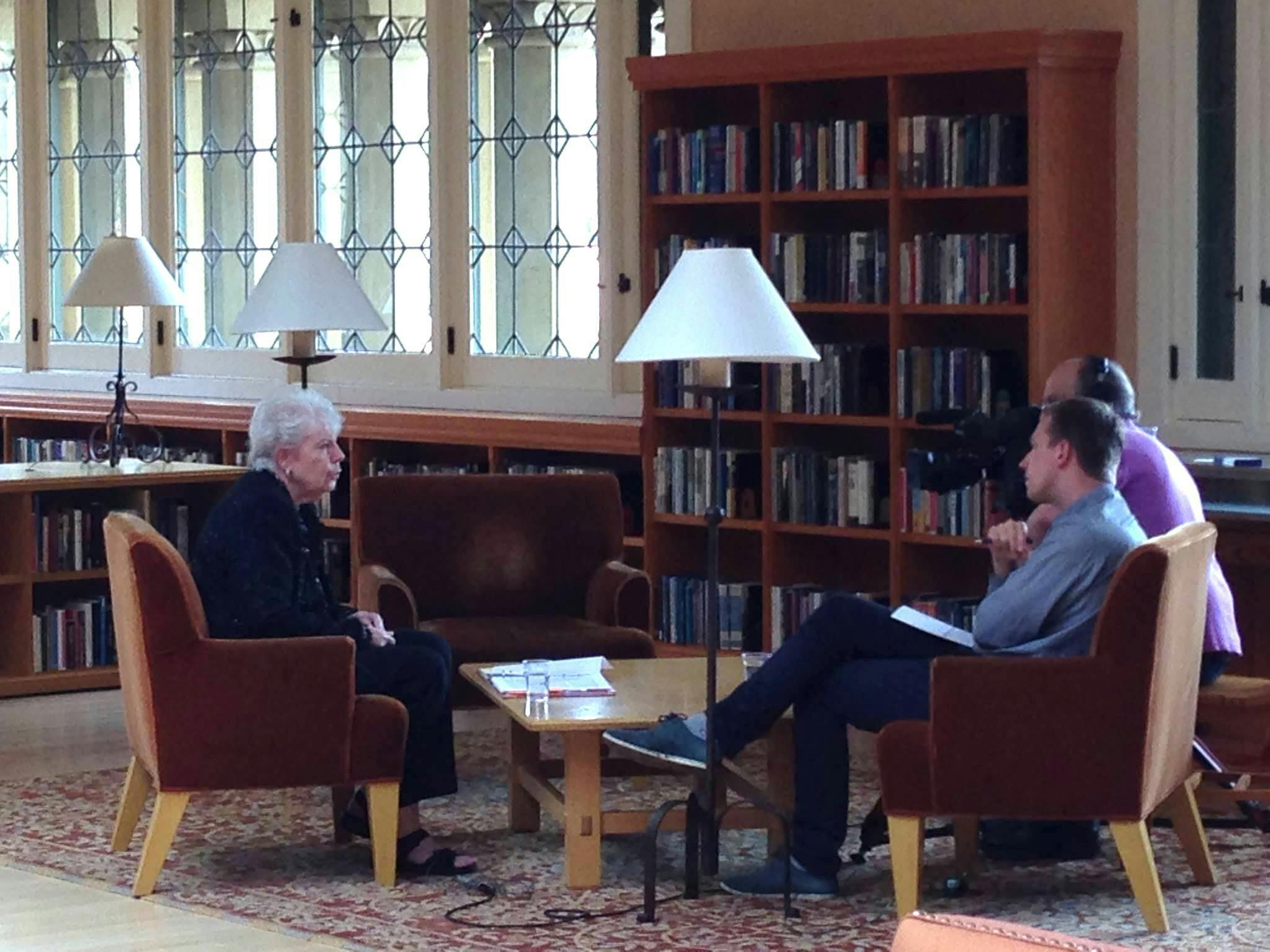
An in-depth interview with Michael A. Keller (University Librarian; Director of Academic Information Resources; Publisher of HighWire Press at Stanford) follows in which he provides insightful, thought-provoking answers to questions involving his role and HighWire's mission, as well as its uniqueness, impact on the market, customer base, competition, partners, and the future.
1. What is HighWire and what is its mission?
MK: "HighWire Press is an enterprise unit of the Stanford University Libraries and Academic Information Resources. Lately we have been describing its mission as both church and state: on the church side HighWire's mission is to enhance scholarly communication by making use of information technologies and global networks; on the state side, HighWire's mission is to affect the marketplace of scholarly reports, typically in the form of journal articles and scholarly monographs. A fuller exposition of these is available at the HighWire Press web-site."
2. How did you arrive at the name?
MK: "After John Sack had begun work as the Associate Publisher and Director of the as-yet-un-named press in the Spring of 1995, he gave me 3 possible names and asked which I liked. HighWire Press was the one we selected because it conveys dual and complementary meanings, those of a press whose works are distributed by wires and of an enterprise involving risk."
3. How long have you been at HighWire? How has your past experience
molded your present interests in electronic publishing. Describe your
transition from musician to electronic publisher: evolution or
revolution or continuum?
MK: "As the founder of HighWire, I have been with it from the beginning. Before even an embryonic form, during my interviews at Stanford, then Vice-Provost and Dean for the Libraries and Academic Information Resources, Bob Street, proposed to me as a candidate and his immediate reporting officers that we discuss how the information and network technology professionals could work with the library professionals on the possibility of using network publication as a counterpoise to the pricing and distribution policies of the for-profit publishers of scientific, technical, and medical journals. At that point, John Sack was Director of the Stanford Data Center. Previously, while I was at Yale as Associate University Librarian and Director of Collection Development, John and I had compared approaches to the same problem. He and Rebecca Lasher Wesley, the Math-Computer Sciences Librarian from Stanford and I with Katherine Branch, the Head of the Yale Science Libraries, were trying to use the capacities of the networks and our institutional computing services to distribute technical reports in math, computer sciences, and electrical engineering from Stanford and pre-prints of math articles from Yale. The Stanford approach became the Networked Computer Science Technical Report Library. The Yale project went through a prototypical period and then went quiet. The roots of HighWire Press thus go far back in time.
In December of 1993, I was presenting to the Stanford Academic Senate the annual report of the Libraries for the previous year and foreshadowing some of the Libraries programs for the coming years. In the question period following my report, Professor of Biology and biochemist Robert Simoni asked me whether I thought CD-ROMs were an effective mode of publication of scientific journals. My response was no and that network publishing was a far better mode of distribution. After that meeting, Bob and I spoke about the challenge the American Society of Biochemistry and Molecular Biology (ASBMB) was having with the growth of the Journal of Biological Chemistry (JBC) which had recently gone from 48 issues per year to 52 issues per year in order to cope. He and some of the other associate editors of the journal along with Chuck Hancock, the executive director of the ASBMB, Herb Tabor, the editor-in-chief, and Ralph Bradshaw, the treasurer of the society, were anxious to consider alternative modes of publication as their science continued to grow. Late in that month, December of 1993, I downloaded my first network browser, Mosaic, and spent nearly a week glued to my work-station at home, itself connected to the Stanford network by an ISDN line. By the end of the first day, it was apparent to me that the final piece of the puzzle was in our hands. With adequate browsers, freely available, network publishing of the reports of scholarship was within sight.
Within a few weeks of the New Year of 1994, Bob Simoni and I started working very hard to convince the publications committee and the finance committee of the ASBMB that an experiment with network publishing of the JBC was in order AND that Stanford wanted to participate in such an experiment. I formed a study team consisting of Ann Mueller from the Stanford Data Center, Sandy Senti from the Stanford Networking Group, and Michael Newman, newly named Head of Stanford's Biology Library. Their charge was to provide functional specifications and a basic technology plan along with a time and fiscal budget for network publication of the JBC. They did a fine job in fairly quick order. Bob Simoni and I then worked for several months with colleagues from the ASBMB. Eventually, in January of 1995. we agreed to fund jointly the design and development of an Internet edition of the JBC. In the middle of all of this, Bob Street returned to his home department, Civil Engineering, leaving me with a new title and some of his former domain; beginning in September of 1994, I was Stanford's first University Librarian (my predecessors had been Directors) and Director of Academic Information Resources, the largest centrally managed academic computer operation at Stanford. As part of this new responsibility, I was given co-ownership of the Stanford's Distributed Computing and Communications Service, which included another piece of academic computing AND the all important Networking group. This new organization was dubbed SUL/AIR.
With this agreement in hand, I approached John Sack to ask him whether he would like to leave the Stanford Data Center and join SUL/AIR as Associate Publisher and Director of HighWire Press. After due consideration, he agreed and began his brilliant career in network publishing in February 1995. He assembled a team of four full-time staff, a couple of co-opted librarians, Michael Newman and Vicky Reich, and some student employees. By May 1995, the first several issues of the JBC were ready and a production scheme with superb through-put was ready in its first form. JBC was an instant success as measured in numbers of hits and the satisfaction of its readers as reflected in the feedback messages (All HighWire Press co-publications include a feedback function). John Sack had begun collaboration during this design and development period with David Lipman, head of the National Center for Biotechnical Information of the National Library of Medicine, the research development arm of the organization responsible for Medline.
In mid-1995, there occurred two events of considerable importance to HighWire's future. First, Jeff Pudewell joined SUL/AIR as Assistant University Librarian for Finance and Administration, whose duties included responsibility for enterprise development. Jeff Pudewell's contribution to HighWire Press and to the publishers for whom HighWire works are in the realms of market analysis and business modeling; he has brought to bear professional and informed skills (he is a librarian as well as a degree'd fiscal officer) on the questions of subscriber demographics, as well as the tactics and strategies available to scholarly societies in meeting their own organizational goals. Second, the new editor of Science Magazine , Floyd Bloom, a reader of the JBC , and Professor of Neurosciences at the Scripps Institute and his colleagues at the American Association for the Advancement of Sciences invited me and John Sack to journey to Washington, D.C. to present the JBC and share with them our experiences in bringing up an Internet edition of the journal. By the time lunch was over, we had begun talking about how HighWire and AAAS/Science might work together to bring out an Internet edition of Science Magazine.
With the launch of a successful Internet edition of the JBC, the most cited scientific journal in the world according to ISI, and the launch in the fall of 1995 of Science Online, another of the most cited scientific journals with a huge global readership, and one of two predominant science news magazines, HighWire's potential for achieving its missions and helping the scholarly societies with which HighWire has been working was apparent. Many other publishers have begun working with HighWire, each with its own desires, styles, business models, and strategies, each an appreciable challenge to HighWire. From the first, we saw that we were successful in prosecuting the church mission of HighWire, that of improving scholarly communication. Lately, as the societies working with HighWire are getting larger shares of authors and readers, we are beginning to see how the state mission might be realized.
The roots of HighWire Press go back into the stimuli of outrageous prices and price increases by the for-profit publishers of scholarship, to experiences with computers and networks beginning literally in my first days as a librarian at SUNY/Buffalo, to early attempts to use the Internet to distribute scholarship in my Yale days, and finally to the superb colleagues, technical resources, and the spirit of entrepreneurship at Stanford University.
A description of the course of a career which began in music and musicology, went through music librarianship to collection development and has landed up in my present set of responsibilities would be tedious. Rather, let me mention a few attributes of my training, education, and experience which have influenced the approaches we have taken here at Stanford and not just in HighWire Press.
As a musician, one is devoted to the piece, to the performance of a work of art. Whether the tuba player has had a tiff with his girlfriend or the oboe player has a bad reed, or the violinist is a radical vegetarian with communitarian leanings, the performance of the work is paramount and all the musicians know this. As a musicologist, I received my education from Steve Bonta, Howard Brown, Jim MacKinnon, Ed Strainchamps, Jim Coover, Tom Walker, Jeremy Noble, and David Fuller among many others. These scholars emphasized accuracy and clarity in understanding and reporting on contexts and historical facts, on musical and social structures, on interpretation and criticism. Theirs is a discipline of depth and delicacy and I am sure that the focus on the stuff of scholarship itself, the music, the composers, the schools and sources, rather than upon historiography or the sociology of musicology affected me. As a librarian, I was lucky to be treated as a colleague by the scholars and performers at Cornell and Berkeley. Giles Shepherd and Henk Edelman, among many others on the staff of the Cornell Libraries in the 1970s, showed me how to stay focused on service to scholarship and the centrality of building great collections to support great scholars. Joe Rosenthal and Dorothy Gregor at Berkeley can only be described as heroic figures; they saw and anticipated the transformation of libraries from print-based to the inclusion of digital sources and services. With virtually no support from any superior at Berkeley, they began the transformation in very intelligent ways. Along the way, I had some wonderful experiences with some colleague music librarians, especially those involved with the systematic retrospective conversion of music catalog records begun with the Associated Music Libraries Group. And at Yale, I had the pleasure to learn more about collection development from my colleagues in the Bibliography Dept as well as from the area curators, from Ralph Franklin, the Director of the Beinecke Library, from Penny Abell, the University Librarian, and from the spectacular faculty and students of that wonderful university. In the Yale years, one could see the function of the University Librarian as orchestra conductor, as herder of cats, as campus leader.
4. How does HighWire differ from other E-journal vendor offerings, and how
is it better?
MK: "It is important to realize that HighWire is NOT presently a
vendor of e-journals. HighWire is a co-publisher of scholarly journals with
Internet editions,
but the subscriptions, including terms and conditions, are declared by the
originating publishers. That said, there is not a single model of HighWire
journals. Each publisher
has different attributes from the others. In general, the e-journals co-
published with HighWire feature easy navigation, generous hyper-linking within a
title, among HighWire titles, to Medline and related meta-data sources, superb
rendition of graphics
and half-tones in varying degrees of resolution, access to information not
available in the printed editions, feedback and communications possibilities to
connect readers to
editors and readers to authors, and superior design work so that the realization
of the publication in the Internet edition is intuitive and easy to read and to
use in scholarship. Readers of HighWire’s journals are delighted also with the
availability of HTML and PDF versions of articles. This combination of forms
satisfies those who wish to scan an article on-line and then print it in page
form as well as those who wish to print the page form
and read it. Publishers working with HighWire have realized that attempting to
restrict access to the content or the ability to copy and print it once a
subscription has been placed is counter-productive to their primary goal, that
of scholarly communication.
5. It appears HighWire has moved from an experimental model to a
production model. Can this model be replicated on other campuses?
MK: "From the first, HighWire Press was intended to be a long-
term enterprise. JBC and Science Magazine were in prototypical
forms in their first Internet incarnations, but HighWire was always intended to
become a significant feature of the scholarly publishing landscape. In order to
do this, however, HighWire’s team must take into account and sometimes lead the
I.T. and networking marketplaces. So, the actual technology at work has evolved
based on opportunities and demands.
We believe in and can see several Internet years in one chronological year.
Scholarly publishers work with HighWire precisely because we can offer both a
distinguished track record as well as a record of responsiveness to their needs
along with leadership in adopting and adapting new technologies to scholarly
network publishing. To do so in a true production environment, one in which we
now are processing about 2,000 page equivalents each week for on-time, high
quality publications, is remarkable. We believe we can scale our approach
rapidly to meet demand, noting that the HighWire team has gone from a group of
four to a group of twenty in just two years.
We believe that the HighWire model can be replicated at other locations and,
indeed, have offered selectively to universities to assist in the promulgation
of our methods elsewhere. To date, there has been substantial interest from
Griffith University in Brisbane, Australia, and from Harrassowitz
in Wiesbaden, Germany. Replicating HighWire elsewhere is not merely buying some
software in shrink-wrapped boxes and applying that software to files of material
ready to be published on the net.
We have also had interest from our colleagues at the Autonomous University of
Mexico (UNAM) in HighWire’s approach. There is lots more to this than meets
the eye, and much of it involves attitudes, styles, and drive as much as great
design, development, and production professionals, engaged and committed
librarians, superb network and server support, and critical masses of
practicing, publishing scholars who share the vision.
6. Generally, what impact will HighWire have on scholarly publishing, and
more specifically on commercial STM publishing?
MK: "Ultimately, we wish to create a marketplace correction which
would result in most of the high impact scholarship being published by the
universities and scholarly societies themselves.
Another way to characterize this correction would be to say that more scholarly
authors and readers were reading low cost, high impact scholarship published by
not-for-profit organizations. With regard to commercial publishing, we hope and
expect to have the effect of lowering prices for low impact scholarship. We hope
to return responsibility for scholarly publishing to those committed to the
primacy of scholarly communication rather than profit taking.
Ironically, the scholarly publishers working with HighWire have discovered that because of their Internet editions, they are finding new readers in distant places. Essentially, the combination of excellent, high impact content with superior design and functionality of the Internet editions, and relatively good distribution of the Internet editions over the public Internet is opening new marketplaces for these publications. This effect of leveling the playing field for distant readers who were previously disadvantaged by delivery of the print editions is enhancing the globalization of the scientific and scholarly communities, a process begun with e-mail. The same process is underscoring the value of membership in the scholarly societies. The ASBMB, for instance, has opened its membership to non North American members as a result of the JBC On-line.
7. Have your market studies revealed what percentage of scholarly
publishing is sponsored by non-profit associations and societies?
MK: Our studies show that about 50% of the titles in the most
cited 500 journals in STM as analyzed by ISI are published by scholarly
societies. More than 50% of the citations and pages are published by scholarly
societies. Much more than 50% of the subscription money goes, however, to
commercial publishers.
A specific study of JBC On-line has been performed by Prof. Carl Gotsch, an economist at Stanford, and Vicky Reich, Assistant Director of HighWire Press with support from the Council on Library and Information Resources. The final version of the paper, "Electronic publishing of scientific journals' effects on users, publishers and librarians," is available at:
<http://www-leland.stanford.edu/~gotsch/lib-research/index.fm.html>
8. What positive feedback have you received about HighWire? What negative
feedback? What are you doing about it?
MK: HighWire has gotten a lot of praise, though that which we
appreciate the most comes from readers who do not know of our work, but make use
of it anyway. We know of cases where parents and relatives of sick persons
learned of a course of therapy as a result of searching journals co-published by
HighWire and succeeded in improving the treatment of diseases and conditions
because of the functions we provide for searching and navigation.
We are gratified to learn about scholars whose work is made easier and more
complete by the use of journals brought to the Web by HighWire.
We are delighted to get more challenges and opportunities from our co-
publishers, thinking especially of our friends at Science Magazine and
JBC, for new functions and new modes of communication. Readers from
formerly disadvantaged venues, those who would have received the paper journals
weeks after publication, let us know that even across difficult network
connections, the investment of minutes for downloading is to them a bearable
price to pay for real-time access to fast-breaking science.
I guess also that the fact that we are now regularly getting a million hits per
day on articles co-published with HighWire is also something of a
compliment.
On the other side, we have heard from readers who are disappointed with the terms of subscriptions; our response to this is to refer them to the originating publishers who set those terms. We fairly often hear from people with problems which turn out to be technical ones. Often readers do not read our suggestions for optimizing their browser. There are a bunch of problems which turn out to be networking problems. Our European readers, for instance, know that they must read HighWire journals before 2:30 their time, because when Internet users in the Eastern time zone of North America turn on their network connections, response and waiting times increase dramatically. To address this latter problem, we have begun serving such remote locations through dedicated band-width to a few remote sites around the world. More such sites will appear in the next months. Extensive research and testing has indicated to us that this solution is far preferable to that of mirror-siting, especially when considering the complexity of our technical architecture. For each of our journals using this global Internet distribution service, there is a special address arrived at by hyper-linking from the journal home page. A reader merely adds that location to his or her list of bookmarks and is conducted directly by Digital Island, the service provider, to our servers here at Stanford, leaping over numerous problems of the public networks.
9. What is the main obstacle between libraries and electronic publishers?
What do you think libraries/librarians want concerning electronic publishing?
(Quality product, stable archive, reasonable pricing?) How will HighWire benefit
libraries?
MK: Our perspective as a library as well as a co-publisher is
that pricing and archiving are the principal concerns.
It is a shame, in a way, that other concerns are not as actively considered. The
importance or impact of the content, for instance should be of paramount
concern. Why libraries and their consortia are so anxious to acquire access to
low impact scholarship for more money than was asked for the print editions is
beyond me. Another issue should be design and hyper-linking to remote
information resources. However, back to pricing and archiving.
So far, with some few exceptions, and those misunderstood, pricing models for
Internet editions have been based on preserving the cost recovery (and in the
case of for-profit publishers, the profit margin as well) of the print run as
well as the Internet publication costs for scholarly journals.
We should begin to see and to appreciate models which deliver lower costs for
Internet editions. The question of who is responsible for the digital archive of
a particular publication is partly a technical and management problem, and
partly a sociological one. We as Internet publishers need to offer archival
versions and/or services upon which libraries can rely.
To date, most librarians want computer-output microfilm as the archival version
of the Internet editions we co-publish. Go figure. Given agreement with our co-
publishers, HighWire is ready to place mag tape versions in escrow, to prepare
CD-ROM versions, and to commit to long-term storage and access here at Stanford.
The sociological questions involve the library community’s making wise decisions
about providing this function which in the print world was quite obviously a by-
product of the collection development policies and practices of each
institution. We now have to depend more distinctly upon certain libraries
functioning as digital archives; most libraries simply do not have the technical
capacity to perform in this way.
Facing and dealing with this reality is apparently a difficult thing, especially
for a number of libraries who consider themselves research libraries and who
have archives. One hopes that we do not lose too much content before the social
questions are settled. The technical and managerial ones are much easier.
HighWire Press has and will benefit libraries by strengthening the role of the publishers of low cost, high impact reports of scholarship. Over time, we expect that their success in scholarly communication among readers and authors, will produce meaningful results for libraries in what and how content is made accessible to academic readers as much as in reduced costs or at least lowered rates of increase of cost. For these results to be realized in their fullest forms, other factors outside of our control, but clearly influenced by the publication of high impact journals on-line, must change -- for instance, more readers have to have good network connections, good enough work-stations or network computers, adequate training and support for their information technology. Another example of a desired change is the acceptability of the networked version of these journals to the exclusion of the printed versions. When the first high impact journal goes entirely digital, a new phase of scholarly communication will have begun. A final example is the availability of well-managed, capacious networks functioning freely around the world.
10.Who do you consider to be your primary customer; the
Association/publisher, libraries, the end-user or other?
MK: Speaking as the Publisher of HighWire Press, our primary
customers are the societies and publishers with which we work.
Speaking as the University Librarian at Stanford, our primary customers are
Stanford’s faculty and students, our readers in general. Speaking as an officer
of Stanford, we at the Stanford Libraries and HighWire are seeking to perform a
couple of missions which address all readers of scholarly publications
everywhere.
There is not a simple answer to the question, but essentially if we do good work
with and for HighWire’s co-publishers, we will have done well for the authors
and readers of scholarship.
As HighWire’s design and development process involves, among other factors, the engagement of readers, we are involving at least representatives of the population of readers in the creation of the Internet editions.
11. Who do you consider to be HighWire's primary competition? In its
entrepreneurial role, how will university-based HighWire continue to compete
with the deep pockets of commercial publishers?
MK: At one level, HighWire essentially does not have any
competition. There are alternate suppliers of services and added content, but
none of them are comparable to HighWire in some ways.
We seem to be competing quite effectively with commercial publishers the way
things have been going. I cannot see any way in which commercial publishers can
compete effectively with HighWire as it is the scholarly and society publishers
as well as university-based publishing organs which we seek to empower. It is
with that group that there is serious competition and we at HighWire seek to
improve and alter the basis of the competition.
Essentially the battle has already been decided in favor of the scholarly and
society publishers in STM on the basis of content; most of the content readers
want is published by not-for-profit publishers.
Now we have to help resolve the battle at the economic level. Since deep pockets
are not the essential or defining difference between HighWire and the commercial
publishers, we believe that we can continue to affect the market correction
mentioned earlier.
12. What do you see as the future of HighWire and electronic publishing in
general; 1-2 years, 5 years and 10 years? What related or evolving products
and/or services do you anticipate spinning-off from HighWire?
MK: In the next few years, HighWire will continue to help bring
significant journals to the Internet in digital editions.
HighWire has received support from the Mellon Foundation and from
Stanford’s president, Gerhard Casper, to create an Internet publishing
capacity for scholarly monographs, working closely with the Stanford
University Press, whose director is Norris Pope. Within a couple of
years, we expect to have several dozen monographs available.
We hope also to have co-published within a few years some reference works as
well. In each of these genres, those of the scholarly monograph and reference
works, we expect to apply the lessons learned and to provide the functionality
provided in the journals co-published with HighWire as well as some new
ones.
We have worked with our colleagues at Science, especially Ellis
Rubinstein and Monica Bradford, in addition to Floyd Bloom,
on
something we are
calling "knowledge environments"®TM,
virtual libraries
and content and services for narrowly defined realms of specific disciplines.
Such "knowledge
environments"®TM may be useful in policy and advocacy
professions well.
In the policy and advocacy realms, in addition to our colleagues at
Science, we are working with Chuck Savitt and his colleagues at
the Island Press, a distinguished not-for-profit environmental publisher.
These and other information products deriving from HighWire and from
SUL/AIR’s experiences are contemplated.
13. The Harrassowitz and HighWire homepages mention a partnership. Please
explain. What do you see as the role of the subscription agent in the
future?
The role of the subscription agent in an age in which the Internet editions
predominate over the print editions of journals is questionable.
We have dealt with subscribers for only a few of the HighWire journals, but have
noticed the number of interactions necessary to open a campus to a subscription;
there is room for re-engineering there, reducing the number of players and
making the interactions much more mechanical.
There is clearly a role for some kind of consolidating agency, however, and
given the predictable growth of computer memory capacity with predictably
lowered costs per unit of memory as well as with the improvement in software
design and operation, it is complete possible and, indeed, highly desirable,
that some subscription agencies assume more responsibilities even while the
number of links in the chain of scholarly communication is reduced.
14. What other partners are involved with HighWire? What will those
partnerships mean to us as librarians?
15. What is your storage capacity for archival data now and for the
future? How will libraries negotiate long-term access?
16. Please comment on the document formats i.e. HTML, SGML, PDF etc. being
used now and what direction is HighWire heading?
17. How many mirrored sites will be added; international and US. How does
the Digital Island arrangement figure into this?
18. What are your thoughts about per-use fees rather than annual
subscription fees to full-text resources?
19. After two years into the project what has surprised you? Any profound
lessons? Have your goals changed?
20. Would you like to add anything?
Get more information about HighWire at:
http://highwire.stanford.edu/.
Copyright 1997 by Michael A. Keller. Licensed for print and digital
publication to Against the Grain by Michael A. Keller.
MK: Harrassowitz and HighWire have entered into a
limited partnership. Friedemann Weigel and his colleague directors of
Harrassowitz along with Joan Griffith, responsible for Harrassowitz’s
Internet presence, are serving as representatives of HighWire’s Internet
publishing services to European publishers, obviously seeking to establish
relationships with scholarly societies and other publishers similar to the ones
now working with HighWire.
Harrassowitz will also serve as the European help desk for readers of HighWire
journals, a first point of contact and assistance. There is every possibility
that the limited relationship with Harrassowitz will become larger, perhaps with
the establishment of a design/development and production operation in Wiesbaden
and perhaps with some responsibilities for marketing and subscriber support.
MK: Griffith University in Brisbane, Australia has a
similar role to that of Harrassowitz and has already negotiated for the
CAUL Libraries in Australia what amounts to a national site license for
JBC in addition to having begun the role of representing HighWire’s
publishing services to Australian publishers.
We fully expect a similar relationship with out colleagues at UNAM. As it has
been my contention that we in North America could address the crisis in foreign
acquisition by stimulating Internet publication in the countries of origin, we
have been encouraged by these relationships to think that readers everywhere
might benefit from the improved distribution of foreign source material and
commentary through the Internet.
The enhancement of scholarly communication is not simply a function to be
performed in North America. Internet publishing in numerous sites can have
significant benefits to our readers.
MK: Our storage capacity for archival data is essentially
unlimited for the moment and for the future.
The main question here is the management of the transition from one storage
medium to another and from one data format to another as these technologies
evolve over time. As we get consensus on data archiving in the library and I.T.
communities, we will have greater assurance of the long-term survivability of
sources in digital form.
As the publishers working with HighWire are every bit as concerned as librarians
and readers are with the development and acceptance of long term data archiving,
we believe that the negotiations will occur with the same degree of acceptance
as consensus is reached on method. Librarians should be negotiating now so that
the subscriptions and licenses preserve the right of access to the Internet
editions for the years the subscriptions were in force.
MK: HTML and PDF formats are in use and available to readers in
most of the HighWire journals.
Underlying these formats are SGML versions in very systematic form. Because the
browsers currently support fewer characters than STM journals employ and because
there are graphics and half-tones included with the texts, gifs are employed as
well. We believe that these document formats will persist and we intend to keep
using them, hoping, however, that the browsers will expand the number of
supported characters. We have been working on the problem of mathematical
equations, but have not yet solved that problem.
We currently present them as images, but seek to make them searchable. Versions
of Tex are a possible approach, but there are technical implications and
limitations involved with Tex as well.
MK: Because of the overhead and technical difficulties with
mirror-siting as a technique, we have resolved upon the use of a global Internet
distribution service rather than establishing mirror sites.
We can see, however, the possibility of sister sites, in Wiesbaden with
Harrassowitz, in Brisbane at Griffiths University, and perhaps in
Mexico City, each with its own particular array of content.
Digital Island gives our readers superior access to the journals by
dedicated bandwidth and very low latency. As the number of local relay sites
provided by Digital Island increases, we believe that many of our remote readers
will see substantial improvement in the delivery times of articles in the
HighWire journals.
MK: I have mixed feelings about per-use fees.
On the one hand, as librarians we make capital investments in information not
just for the current populations of readers in our institutions, but for future
generations as well. Thus, expending capital on information as though it were
merely a utility is onerous.
On the other hand, if reliance on per-use fees for low impact information allows
more selective capital investments in high impact information, then my instincts
as a collections person might be satisfied. The expansion of reliance on per-use
fees might accelerate the market correction we at HighWire are involved with as
well.
MK: The enthusiasm for the on-line versions by readers has
surprised us. The warmth and strength of our relationships with our co-
publishers has been a wonderful surprise.
The examples of the JBC and Science have been mentioned only and
are quite pervasive ones, but the other relationships with the other publishers
have been wonderful and quite productive as well.
The most profound lesson to date is that HighWire demonstrates what a small, but
brilliant band of professionals can do to affect change given the focus on the
mission, on satisfying authors, editors, readers, publishers using information
technology. Our goals have not changed, though our methods and technologies
have.
MK: I can promise only that the future will bring as many
opportunities and changes as the recent past. Not only HighWire, but Stanford in
general seeks to exploit the opportunities to the advantage of its academic
community and for the colleague communities elsewhere.