Archive to artistry
Mid-Peninsula High School students explore the “Art of Noises” at Stanford.
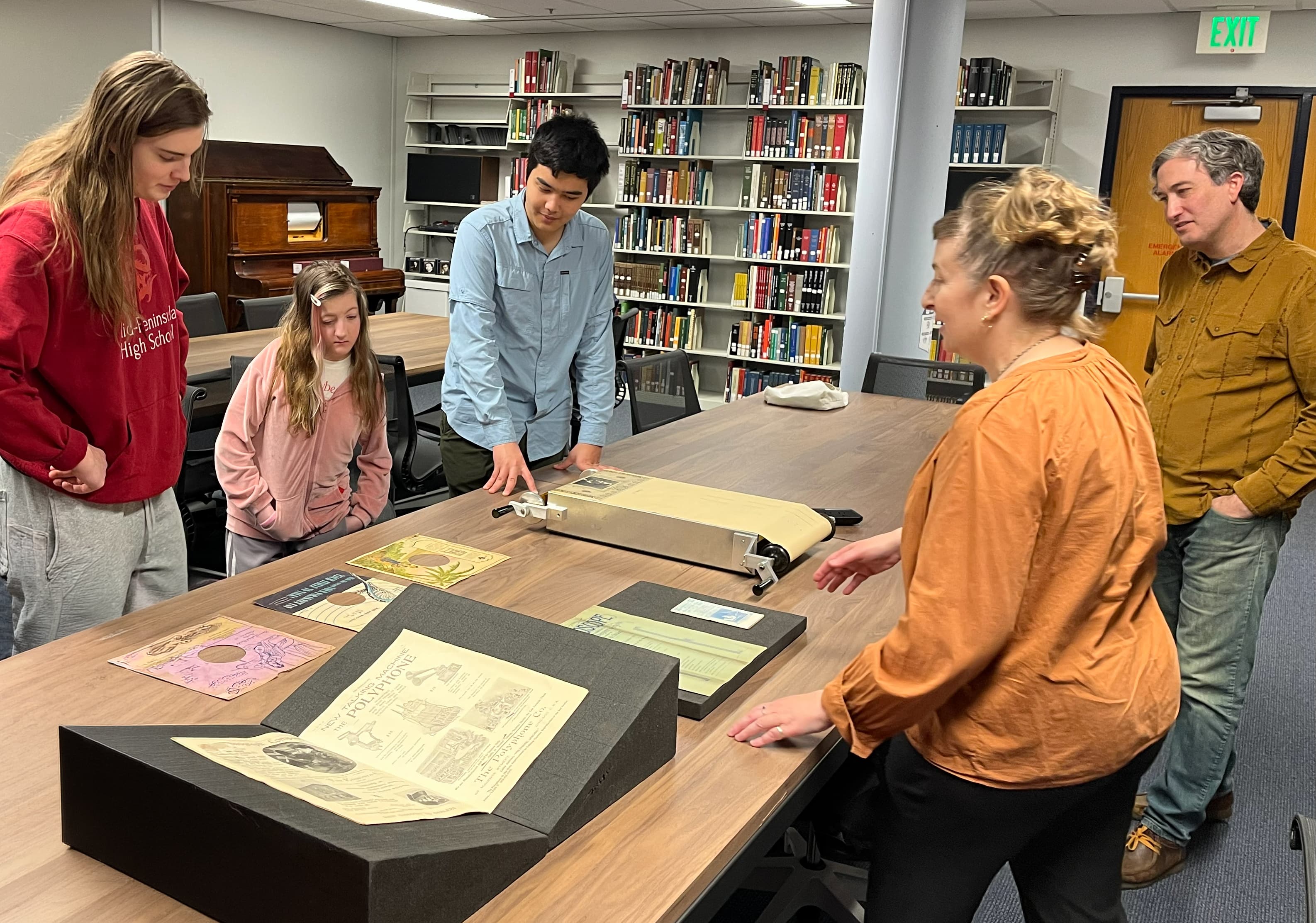
Seven students from Mid-Peninsula High School, an independent college preparatory program founded in 1979 and located in Menlo Park, recently explored Stanford’s music-related laboratories and libraries as part of their intersession course, The Art of Noises. This weeklong class was co-taught by Jameson Swanagon, the Department Chair for Performing and Visual Arts at Mid-Pen, and Hannah Frost, the Associate Director of Digital Library Services at Stanford University Libraries.

The Art of Noises emphasized the significance of sound as an artistic medium, as well as its presence in archives. The course sought to “bring students into the dynamic fold of composers and sound artists who have found evocative source material in the artifacts of recorded sound.” Its measurable objective was to “deepen the students’ relationship with recorded audio into an artistic practice” through the completion of final projects using archival materials.
The course began with a screening of the documentary film Ryuichi Sakamoto: Coda, which chronicles the life of the late Japanese composer, musician, and producer known for his exploration of ambient and non-musical sound sources, as well as his environmental activism following the Fukushima disaster. The screening was complemented by a listening session that offered a history and overview of sound composition techniques, highlighting the distinctive methods employed by eight different artists.
On the next day, a workshop was conducted in the Stanford Media Preservation Lab, located on the Redwood City campus. Students were introduced to two key software platforms widely used in the music, film, and audio production industries: Max/MSP, a visual programming language often utilized for creating "Music Concrète" patches, and Pro Tools, a professional digital audio workstation. These tools enabled them to compose with sounds derived from musical instruments, the human voice, the natural environment, and computers and synthesizers.

The workshop equipped the students with the technical skills to creatively manipulate sound and explore the artistic potential of recorded audio in their own compositions. “As a hands-on learning experience in media digitization, the students were invited to bring in old tapes from home,” said Frost. “They later combined snippets from their digitized tapes with field recordings and public domain audio downloads in the creation of a ‘found sound’ piece. The results were impressive, and the students had a wonderful time.”
The following day, the students visited Stanford’s Music Library & Archive of Recorded Sound, where they saw examples of graphic scores and learned about doing research with sound archives. A highlight of the experience was listening to historic discs on phonographs and early twentieth-century piano rolls on an antique player piano.

For their culminating projects, the students created musical compositions that combined a digitized audio artifact from cylinder, disc, or tape formats; a field recording made by the student; and sounds produced using musical instruments, synthesizers, or other sonorous objects. “The goal was for them to use archival material to create artworks at the intersection of music, sound design, poetry, and radio documentary. Concurrently, they explored the techniques of crafting, curating, and manipulating recorded sound into music,” Swanagon said.
In retrospect, the students' access to historical audio artifacts significantly deepened their understanding of sound and its transformative potential in art. By integrating academic experiences with hands-on learning, they not only gained technical skills, but also discovered the rich stories and contexts behind each sound they manipulated.
Sunday, a student in the class, remarked: "I like how we were able to find meaning in music that on the surface makes no sense. We were able to find the logic behind its organization and enjoy the sounds in a new way."
This collaborative program underscored the importance of preserving sound history, fostering creativity in young artists, and encouraging innovative approaches to composition. The success of this initiative would not have been possible without the dedicated efforts of the Stanford University Libraries staff, whose support and expertise guided the students throughout this informative journey.