Art Tatum’s “The Greatest Piano of Them All”
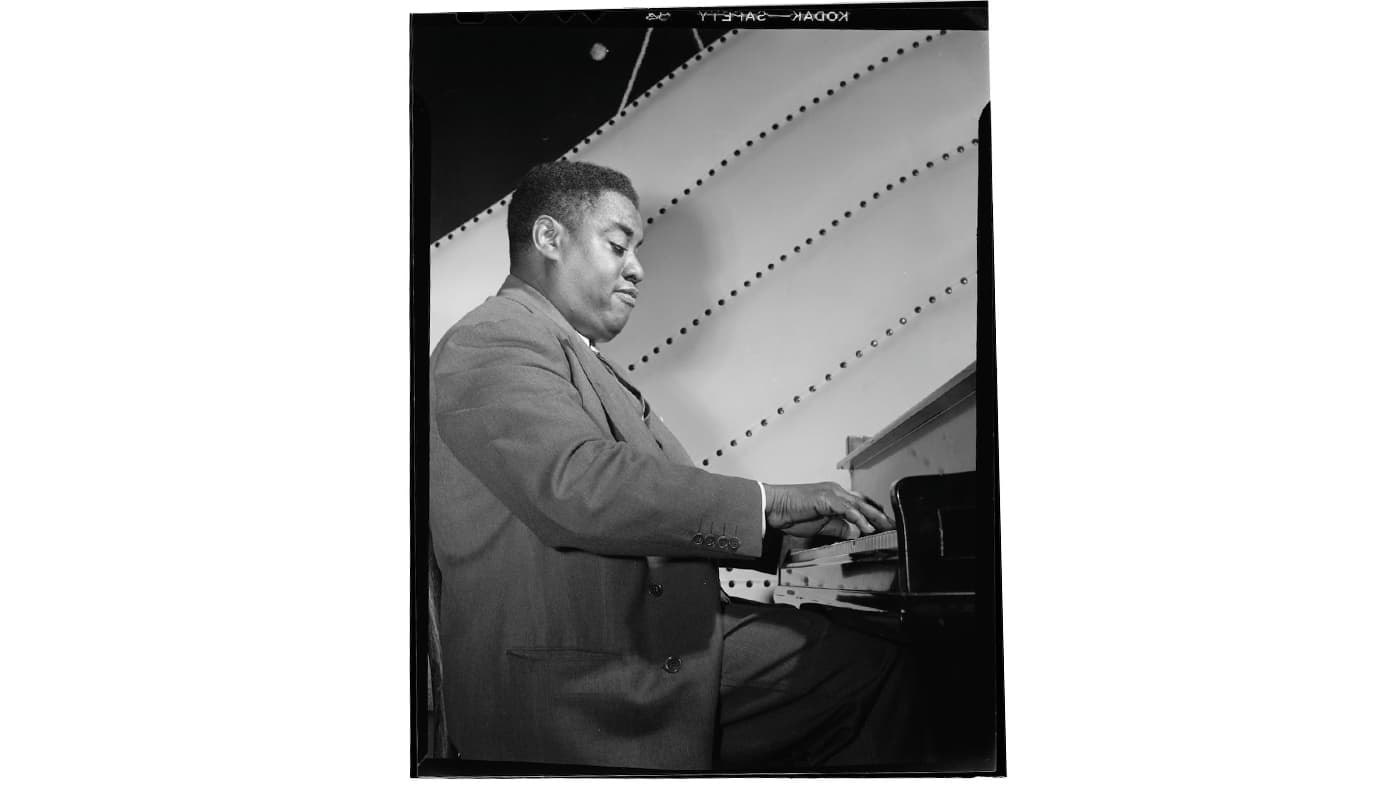
When the needle drops on The Greatest Piano of Them All, the piano does not ease into the room—it claims it.
This Verve Records reissue (MG V-8323), preserved in Stanford University Libraries’ Dijkstra Black Music Collection, documents a solo piano session recorded in Los Angeles on April 22, 1954. The performer was Art Tatum (1909–1956), already regarded as one of the most technically formidable pianists in jazz history. The session was produced by Norman Granz, founder of Verve Records and Jazz at the Philharmonic, whose mid-century recording projects sought to document leading jazz musicians with a new level of studio clarity and artistic seriousness.
The album consists of nine American standards: “Deep Purple,” “Somebody Loves Me,” “I Didn’t Know What Time It Was,” “What’s New,” “You’re Blasé,” “You’re Mine, You,” “That Old Feeling,” “Heat Wave,” and “She’s Funny That Way.” Familiar repertoire becomes something else entirely in Tatum’s hands. Rather than merely interpreting these songs, he reconfigures them from within.
On “I Didn’t Know What Time It Was,” the opening chords immediately complicate expectation. Harmonic substitutions destabilize the tonal center before resolving with effortless control. The left hand anchors the harmonic foundation while the right hand unfolds in cascading chromatic runs that feel orchestral in scale. What first sounds like sheer density gradually reveals itself as carefully structured harmony.
“Heat Wave” highlights another hallmark of Tatum’s playing: velocity without blur. The tempo pushes forward at breathtaking speed, yet every note remains crisply articulated. Patterns emerge and dissolve in real time, demonstrating that speed here is not spectacle but structural clarity.
There is also restraint. On “What’s New,” the tempo relaxes and melodic phrasing becomes more exposed. The density thins just enough to reveal Tatum’s touch—shaped, controlled, attentive to contour. These quieter moments underscore that his virtuosity was not merely technical display; it was expressive command.
By 1954, recording technology had advanced significantly from the shellac-era limitations of earlier jazz releases. Norman Granz’s recording projects sought to capture leading musicians with improved fidelity, preserving improvisation as something more durable than a fleeting performance. Sessions like this one helped establish jazz recordings not simply as entertainment but as lasting artistic documents.
The liner notes for this Verve pressing were written by Oscar Peterson, himself one of the most technically formidable jazz pianists of the twentieth century. Peterson’s presence on the album signals the extraordinary respect Tatum commanded among fellow musicians. Many later pianists cited Tatum as a defining influence, and his harmonic vocabulary and technical scope reshaped what jazz piano could encompass.
Preserved today in Stanford University Libraries’ Dijkstra Black Music Collection, The Greatest Piano of Them All stands as both musical document and cultural artifact. It captures a moment when jazz was being consciously recorded and preserved with new seriousness, reflecting a broader archival effort to document Black musical innovation within American cultural history.
The title risks sounding like hyperbole. Yet, listening to these recordings clarifies why such a claim circulated. Tatum did more than play standards brilliantly; he stretched their harmonic possibilities until they felt elastic and inexhaustible. More than seventy years after its original recording, the album remains a testament to virtuosity, preservation, and the evolving place of jazz within American musical memory.
Sama AbuZayyad (‘28) is majoring in electrical engineering and minoring in music.
This article is part of a series highlighting albums in Stanford’s Dijkstra Black Music Collection. The series was written by students in Music 147U: Identity, Difference, Sound, under the supervision of Ioanida Costache and John Fath. We are grateful to Nathan Coy, the entire ARS staff, Ray Heigemeir, Tamar Barzel, and Rochelle Lundy for their support of this work.