Cap, Gown, and Capstone
An Undergraduate Showcase of Creative Expressions in Scientific Inquiry
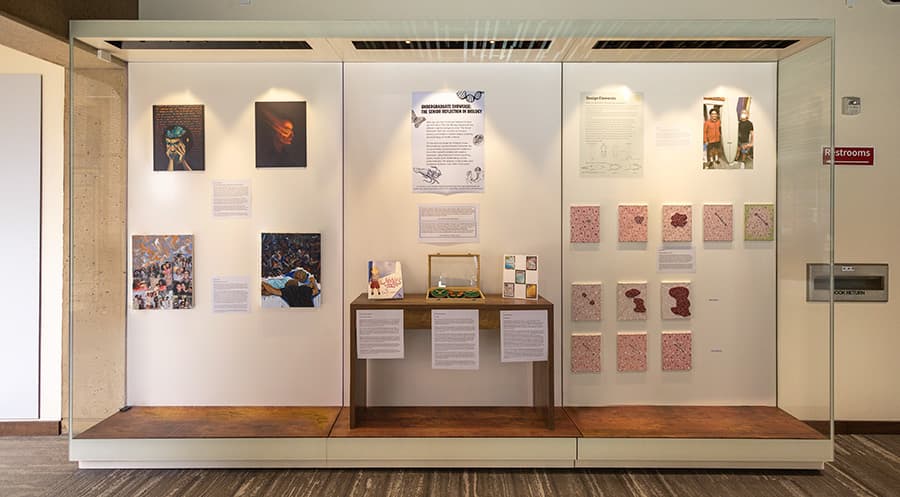
An ongoing exhibition in Green Library’s Hohbach Hall showcases the Biology Senior Reflection, a unique course offered since 2010 by Susan McConnell, the Susan B. Ford Professor of Biology, Emerita, and Andrew Todhunter, Lecturer in Biology. The displayed projects feature students exploring scientific content through creative forms, complemented by accompanying essays that delve into the creative process and the scientific significance of their chosen topics. The exhibit exemplifies an innovative capstone project that effectively bridges the fields of science, arts, and humanities.
A capstone in the major, required for all majors beginning with students graduating in 2024-25, provides students with an opportunity for deeper engagement with their field of study and an opportunity to integrate and apply their learning through the major to a topic of interest. This project can take the form of an honors thesis, a senior paper or project, independent research, or an arts performance or exhibition. Another type, known as the senior synthesis project, adopts a more interdisciplinary approach and may involve community partnerships. The capstone program grants intellectual flexibility and independence while fostering the management of complex projects, the synthesis of knowledge and skills, and real-world problem-solving and social engagement.
“Alumni often remember their capstones as a formative and meaningful experience that represents the culmination of their undergraduate studies at Stanford,” said Laura Schlosberg, Assistant Dean of Academic and Curricular Support in the School of Humanities and Sciences, who assisted with the implementation of the requirement in the school. “Saving capstone projects to the Stanford Digital Repository provides students with a way to preserve their work and leave an enduring impression of their undergraduate intellectual experiences at the university,” she added.

The Stanford Digital Repository, launched by Stanford University Libraries in 2006 to enhance access to its archives and special collections, began accepting dissertations in 2009. It has since expanded its support to facilitate the management of scholarly information for the entire Stanford community. This repository enables faculty, students, and researchers to preserve their work and, if they choose, make it openly accessible to scholars worldwide. Today, it hosts approximately 25 distinct graduate student collections and 50 undergraduate collections of theses and projects, each discoverable in the library catalog and managed by a relevant subject specialist who assists students in depositing their work and in other aspects of academic research and publication.
“Student capstones are content worth saving,” stated Hannah Frost, Associate Director for Digital Library Services. Creative Commons, an organization founded at Stanford that supports open access, provides free tools and flexible copyright licenses, allowing students to share their work while retaining certain rights. “As a result, capstone projects form an ever-growing collection that can be utilized by faculty and administration for curriculum review, by future students seeking inspiration for their own capstone experiences, and by alumni who can proudly link to them on their CVs,” Frost added.

James Hamilton, the Freeman-Thornton Chair for the Vice Provost for Undergraduate Education, further highlighted the benefits of the Stanford Digital Repository: “Capstone projects at their best combine creativity and critical thinking. Archiving these projects allows students to demonstrate to the world how curiosity and insight can lead to discovery.”
The Biology Senior Reflection exhibit at Green Library was curated by Pauline Lewis, Bogdana Marchis, and Phyllis Kayten and features the works of seven students from the program. On display are a squid-inspired surfboard design; surrealist digital paintings that narrate chronic illness and invisible disability; mixed-media paintings exploring the biological progression of cancer; a set of trading cards with healthcare access information for the chronically homeless; embroidered butterflies from species that are on the path to extinction; a photographic collage of inspirational Black mothers, who as a group are at a higher risk of maternal mortality; and an illustrated book for pre-teens about chronic respiratory illness in children.

Lewis, a reference and instruction librarian, said, “We are thrilled to showcase these creative student works that transcend disciplinary boundaries. It’s our third installment of the Undergraduate Showcase exhibit series, which highlights undergraduate works of research and creativity, and we hope to exhibit more capstone projects in the future.”
“The Senior Reflection invites seniors in science-related majors to pursue an in-depth capstone project that lets them explore a personally meaningful scientific topic through a creative medium of their choice. This fusion of art and science has inspired students to produce work that sparks the imagination, informs and educates viewers, and deepens our appreciation for the beauty and significance of science in our lives,” said Professor Susan McConnell.
McConnell’s teaching colleague, Andrew Todhunter, added: “In a culture characterized by the fuzzy techie divide, the ability to interweave art and science in a single project is all too rare, and a wonderful chance for students to integrate these seemingly disparate but complementary parts of themselves. Our students discover that their art need not diminish their commitment to science—or vice versa—and that each can shed a powerful light on the other.”