Imprints and Imports: The First Books and Pamphlets in California
A vault full of early "Californiana" presents a golden opportunity for researchers at Stanford University Libraries.
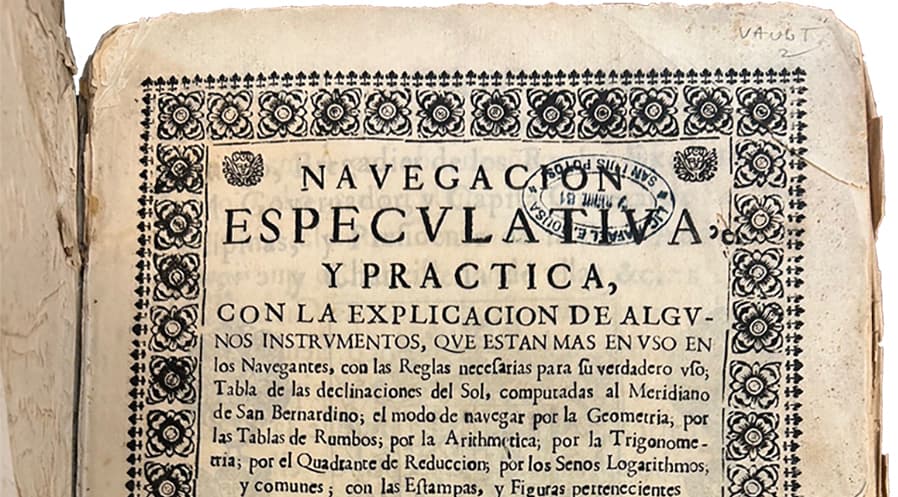
Coinciding with the 100th anniversary of rare book collecting at Stanford University Libraries, the oldest and rarest books from the California Historical Society (CHS), which were previously housed in a climate-controlled vault in the disbanded organization’s building in San Francisco, are now accessible to researchers.
“Rare books, particularly the scarce remnants of those written or produced in pre-statehood California, are crucial for understanding the state's complex history and rich culture,” said Michael A. Keller, the Ida M. Green University Librarian at Stanford. “These texts not only provide valuable insights into the historical context of the time but also illuminate the diverse narratives that shape our understanding of California’s heritage.”
The late Gary F. Kurutz, an esteemed bibliographer who once served as the Director of Special Collections at the CHS and profoundly influenced the collections at the Sutro Library, the Huntington Library, and the California State Library, stated in a 2003 report: “The [CHS] book and pamphlet collection consists of approximately 50,000 titles and stands as one of the largest assemblages of printed Californiana found anywhere. It is a collection that instills pride in the incomparable richness of California history."

Kurutz also acknowledged the contributions of foundational CHS benefactors such as C. Templeton Crocker and Albert Bender. The latter, along with his associates, is featured in the current exhibition in Green Library titled Finely Printed Books: Albert Bender and the Birth of Stanford Special Collections. The Crocker Collection, as Kurutz noted, contains unique rarities, including the first book printed in California, the first pamphlet printed in Sacramento, as well as hand-tinted plate books, state atlases, overland narratives, and books highly significant for their associations, presentations, and annotations.
“Stanford University Libraries was traditionally underrepresented in this area, often deferring to Berkeley in reciprocal collecting agreements during its formative years,” said Rare Books Curator Ben Albritton. He added, “The stewardship of the CHS collections has significantly expanded our rare book holdings from fewer than 5,000 California titles to approximately 35,000. This represents a transformational shift in the overall composition of our collections, with over 10% now related to California, a sharp increase from about 2.5%.”

“The first tranche of several hundred books, known as the Vault Book Collection, with a few exceptions needing preservation treatment or cataloging refinement, have been released into the online catalog, SearchWorks, and are fully accessible to researchers,” said Frances Kaplan, Archivist for the CHS Collection at Stanford. “Of the approximately 50,000 books and pamphlets in the entire CHS Collection, close to 30,000 had MARC (machine-readable cataloging) records that the metadata department was able to import into Stanford’s library services platform, FOLIO,” Kaplan stated. The released books also underwent end-processing to replace worn or missing shelf tags, add barcodes and security embossing, and, in some cases, construct preservation boxes.

“The Vault Books, spanning centuries of California history, include a 1576 edition of the Spanish novel believed to be the first to mention ‘California,’ a 1734 book published in Manila on speculative and practical navigation, an 1839 narrative of fur trapping adventures, the 1850 San Francisco City Directory by Charles P. Kimball, and an 1854 guide to conversations in Chinese and English,” said Kaplan. She added, “The Vault Broadsides also include many one-of-a-kind items, such as the 1839 census of Mission Santa Clara and the 1850 preamble and resolutions read at the Sonora town meeting.”
Agustín V. Zamorano (1798-1842) is well known among book historians and collectors. He established a wood-frame Ramage press in Monterey, where he printed the first books, official documents, and the newspaper The Californian in Alta California territory. Zamorano is also the namesake of Southern California's Zamorano Club, founded in 1928, and the club's influential Zamorano Eighty, a checklist of first editions of the most important early books on California that very few collectors have completed. The Kemble Collections on Western Printing and Publishing, a core component of the CHS Collection, includes many treasures from Northern California's legendary printers, such as John Nash and the Grabhorn Press.

"The early California printing in the CHS collection provides a critical mass of resources for research and serendipitous surprises that will attract anyone interested in bibliographical thoroughness, later editions, variant bindings, presentation inscriptions, and author's notes," said Albritton. "It also facilitates comparative analysis, such as between works printed by the Zamorano Press when it was in Monterey, and after it had been moved to Sonoma where it was known as the Spanish Press."
While examining the back of a Monterey-printed Zamorano broadside, Albritton discovered a handwritten poem that he identified as the text of a Spanish canción, "El dulce bien por quien suspiro," which was set to music for both guitar and piano accompaniments. “One can almost imagine this being the hottest new track imported from Spain when it was written down in California,” he said, “and it appears to have been a very popular romantic song in Mexico.”

The historical Spanish Press, established in 1823 at Mission San Francisco Solano in Sonoma, is also well represented in the CHS Collection. Albritton found a duplicate of an item at Stanford among a group of publications printed at the request of General Vallejo. The Stanford copy has a well-documented provenance of four owners, concluding with William Bourn, who constructed the Filoli estate in Woodside. “The pamphlets included in the CHS Collection are vanishingly rare,” he said, “so to be able to compare side-by-side in a single institution is fantastic when studying both early California print and reader interactions.”
This article is the fifth in a series about the California Historical Society Collection at Stanford University Libraries. More information can be found on the CHS Collection at Stanford website. Please direct all inquiries to: chscollection@stanford.edu.
Prior Articles
- Trove of California history to be housed at Stanford (January 2025)
- California Historical Society Collection: First Quarterly Update (April 2025)
- Reopening the California Historical Society Collection at Stanford (July 2025)
- Photographs in the California Historical Society Collection at Stanford (October 2025)