A lesson in counterpoint
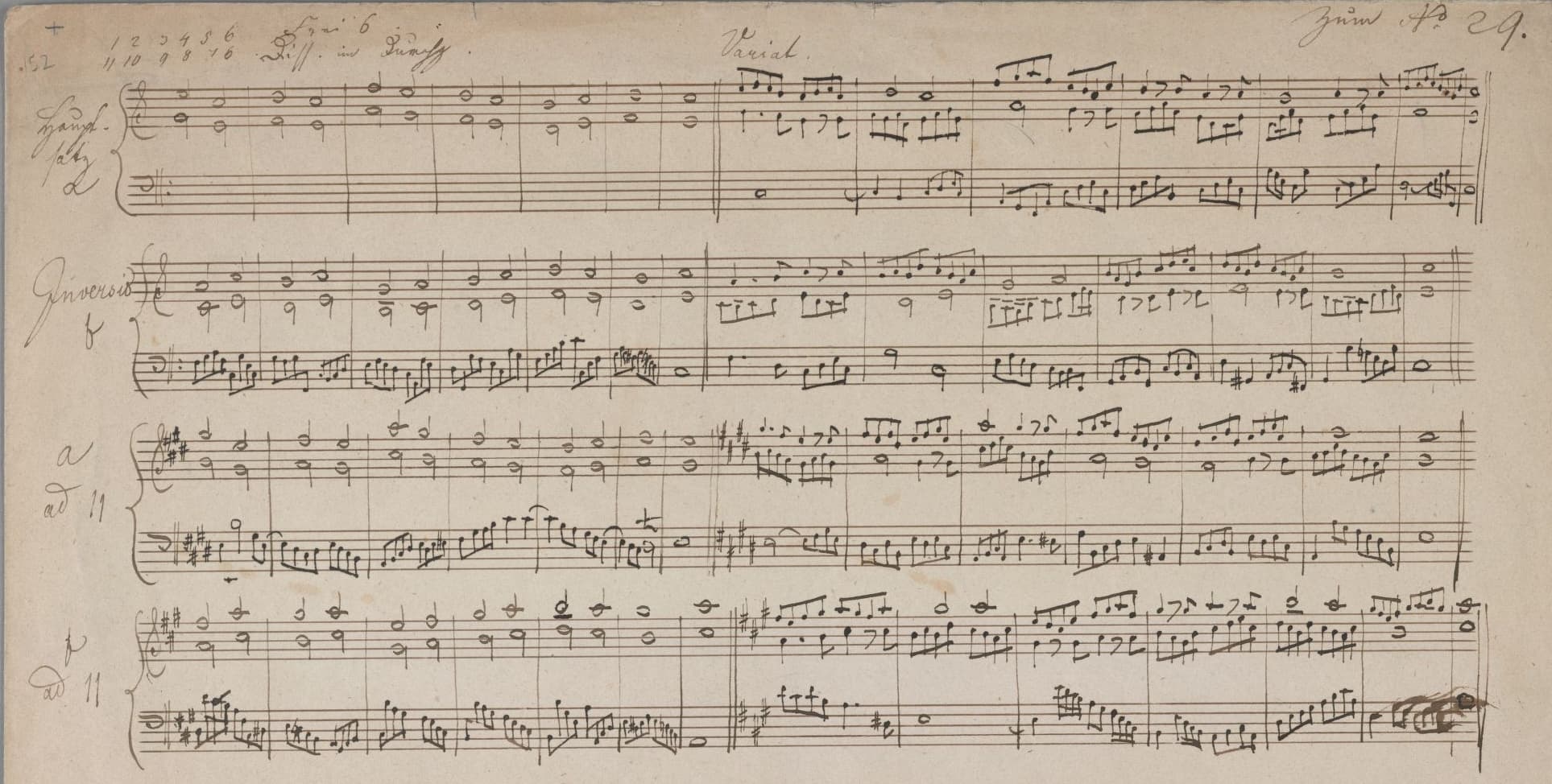
The prominent 19th-century symphonist Anton Bruckner composed his First Symphony proper at the age of 41, after several earlier attempts in the genre. He is not exactly known as an early bloomer, and this sheet of counterpoint exercises helps illuminate why.
Bruckner’s career is characterized by a unique trait: he restarted his musical education in his thirties. By that time, his training could have been considered complete. He had studied with four teachers, had composed larger-scale works like the Requiem, WAB 39, and the Missa solemnis, WAB 29. And he was a renowned church musician and organist, first at St. Florian, and later at the Cathedral in Linz, the capital of Upper Austria. And yet, at the age of 31, Bruckner returned to the basics of music theory for a whopping six years, learning harmony, counterpoint, canon, and fugue all over again. It was actually the aforementioned Missa solemnis that served as the submission piece that got him accepted as student by Simon Sechter, professor at the Conservatorium of the Gesellschaft der Musikfreunde.
These studies were cumbersome! Living and working in Upper Austria, Bruckner had to travel some 120 miles to meet his teacher. Due to his work commitments, Bruckner could stay away only for limited periods, mainly during summer and Lent. Years later, on May 9th, 1884, he would recall in a letter: “In Linz, I have studied 7 hours a day … and I travelled to Vienna 1 or 2 times a year for 6–7 weeks, where I passed the whole day with the professor.” The rest of the time, he corresponded with Sechter by mail, often exchanging assignments via his friend Rudolf Weinwurm.
The manuscript preserved in the Memorial Library of Music at Stanford represents this challenging period in Bruckner’s life. Only the first page of the bifolium bears any writing, featuring exercises on invertible counterpoint.
In invertible (or double) counterpoint, the voice leading needs to be correct not only in its original form, but also when the voices are exchanged, with the upper voice becoming the lower by moving one (or both) of the voices. The inversion at the octave is the most common one, as illustrated in the first excerpt from Simon Sechters book Die Grundsätze der musikalischen Komposition (1853-1854).

When the upper voice is transposed down by an octave, all of the fourths turn into fifths, the thirds into sixths, and the unisons into octaves. These effects of a certain inversion interval are commonly presented as a table.

Inversion at the octave is quite straightforward, as most consonances remain consonances: the unison (1) becomes an octave (8) and a third (3) becomes a sixth (6). Dissonances likewise remain dissonances: a second (2) becomes a seventh (7) and vice versa. Only the fourths and fifths must be treated with caution, as a perfect consonance (5th) will turn into a dissonance and vice versa, both requiring specific treatment. But on this sheet, Bruckner works through invertible counterpoint at the eleventh. As shown in the second example from Sechter’s book, the upper voice is again transposed downward, this time by an eleventh.

In the upper left of the manuscript, we find Bruckner’s summary of the changes.

He adds: „Freie 6. // Diss. im Durchg.“: Only the sixths may be used freely; every other interval, involving a dissonance in original or inversion, may only be used as a passing tone.
The exercises on the present sheet are not about finding resolutions for this kind of counterpoint, though. At this point in time, Bruckner has written about a hundred pages of exercises in double counterpoint at all intervals of inversion and is now building upon these abilities and figuring out the correct voice leading for an added third voice.
A manuscript closely related to the Stanford page confirms this. The corresponding leaf in a study book of Bruckner’s which is held by the Austrian National Library states “Doppelter Contrap. Gegenbew. mit doppelt. Contrap. der Undez.”

So we don’t need to second-guess what Bruckner is up to: “Double counterpoint. Contrary motion with double counterpoint of the eleventh.” Adding a third voice creates triads and thus establishes specific harmonic progressions and the stemless note heads below the three-voice setting represent its “fundamentals.” This is the core of Sechter’s method, which aims at the synthesis of harmony and counterpoint. It uses Rameau’s idea of a “root tone” that could differ from the actual bass or not be present at all. Given how music had evolved since the Baroque era, this concept was anachronistic at the time and criticized for being ignorant of melody and form. In later years, Heinrich Schenker, a student of Bruckner’s, regarded it as “nonsensical teaching.” (Stocken, p. 26)
Apart from what the manuscript tells us content-wise, the connection to the Vienna material also provides us with the exact date of its creation. Bruckner habitually interspersed his manuscripts with dates and even times of the day. The type of exercise we find on the Stanford sheet falls neatly between similar exercises that bear the date ”February 10th, 3:45 am” and “February 12th, 2 am” of 1859.
Could the Stanford page have been written in the early morning hours of February 11th, 1859? In most cases, one would be hesitant to draw such a conclusion based on one clue only. Taking Bruckner’s systematic working process into account, though, the odds favor it. Bruckner followed the itinerary laid out in Simon Sechter’s book faithfully, filling pages and pages with the prescribed assignments. So in short, this is a story of sustained and intense effort in an endeavor of debatable merit. It remains difficult to fully explain where Bruckner’s drive to excellence in music theory stemmed from. Mostly, it has been connected to his mental state, his longing for external validation and his compulsive nature. In any way, it laid the foundation for one of the most idiosyncratic and polyphonically educated symphonic oeuvres of the 19th century.
For further reading
- “2. Studienbuch bei Simon Sechter – WAB add 247,” in: Digitales Werkverzeichnis Anton Bruckner, hg. von Robert Klugseder und Clemens Gubsch.
- Anton Bruckner Kritische Gesamtausgabe: Band 24/1: Briefe 1, 1852–1886. Musikwissenschaftlicher Verlag der Internationalen Bruckner-Gesellschaft, Vienna, 2009.
- Sechter, Simon: Die Grundsätze der musikalischen Komposition, Breitkopf und Härtel, Leipzig 1853–1854.
Stocken, Frederick: Simon Sechter’s fundamental-bass theory and its influence on the music of Anton Bruckner, Mellen, Lewiston 2009.
Benedikt Lodes is the director of the Music Department of the Austrian National Library and the head of the Archive of the Austrian Folk Song Institute. He is a Stanford Library Fellow for the 2025/26 academic year.