A Love Story in Five Books
Professor Jessica Riskin unveiled five cherished volumes at the recent exhibition opening of Finely Printed Books: Albert Bender and the Birth of Stanford Special Collections
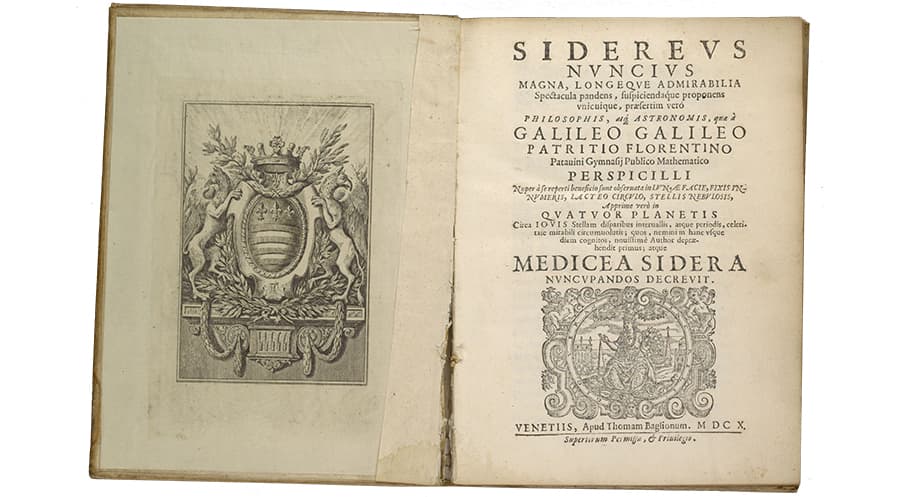
The final week of February proved to be an exciting time for Bay Area bibliophiles, highlighted by the launch of an exhibition commemorating the 100th anniversary of rare book collecting at Stanford University Libraries, which coincided with the 57th California International Antiquarian Book Fair in San Francisco.
Finely Printed Books: Albert Bender and the Birth of Stanford Special Collections displays dazzling specimens from some of the world's most esteemed fine presses and printers, with a particular focus on California-based presses, donated by Albert Bender and his contemporaries between 1926 and 1941. These generous gifts led to the appointment of the first curator of rare books, the establishment of the first dedicated space for housing and using rare materials, and eventually to the development of a Department of Special Collections at Stanford.
Acknowledgment is also given to the librarians who played a pivotal role in ushering in this new era of collecting and who began the transformative journey from a disparate collection of rare and antiquarian books acquired during the university's early years to a meticulously organized Department of Special Collections that serves the faculty and students of a leading research institution. We cordially invite you to explore the exhibition, on display at Green Library until May 17, as well as its parallel and less ephemeral digital counterpart available online.
At the exhibit opening, Jessica Riskin, the Frances and Charles Field Professor of History, described her teaching and research in the Special Collections reading room—also named for Frances and Charles Field—as “A Love Story in Five Books.” The oldest of these, a copy of Galileo’s Sidereus Nuncius, or Starry Messenger (1610), pictured above, is one of nine known to have been printed on extra-thick paper in a presentation binding and represents a seminal text in the history of telescope use. “I show it and other first editions in my Scientific Revolution class every year. Our Special Collections visit is always the high point. For students, seeing this book is like seeing a movie star in person.”

Riskin selected two additional seventeenth-century editions. “I used another copy of Isaac de Caus’s Nouuelle inuention de lever l'eau, or New Invention for Lifting Water (1644) in my book, The Restless Clock, as an example of how people have used artificial machines to try to understand living beings. In Science in the Making, a course that I offer with Paula Findlen, the Ubaldo Pierotti Professor of History, and with the assistance of Rare Books Curator Ben Albritton, students meet in Special Collections each week to present in turn on early modern scientific works such as Robert Hooke’s Micrographia, or Some Physiological Descriptions of Minute Bodies Made by Magnifying Glasses (1665).”


Riskin concluded her ode to Special Collections with praise for two nineteenth-century volumes: “Lamarck’s Philosophie zoologique (1809) is discussed at length in my forthcoming book, The Power of Life: The Invention of Biology and the Revolutionary Science of Jean-Baptiste Lamarck. The Stanford copy has the lovely bookplate of Stephen Jay Gould, my undergraduate thesis advisor and early career mentor."

Caroline Winterer, the William Robertson Coe Professor of History and American Studies, along with Riskin, used Charles Darwin’s The Expression of the Emotions in Man and Animals (1872) for their project, The Apes & Us: A Century of Representations of Our Closest Relatives. “Our project was a five-ring circus,” said Riskin, adding, “Darwin’s sulky chimpanzee has appeared in its art exhibit, catalogue, workshop, sophomore seminar, and now an edited volume of essays. Special Collections was crucial to each of these endeavors.”
As we continue to celebrate a century of rare book collecting this year, we will invite several staff members from Stanford University Libraries to share their favorite books in an upcoming sequel to this article.