New eyes on old pages
Students bring a fresh perspective to Bowes Art and Architecture Library’s rare and unique materials.
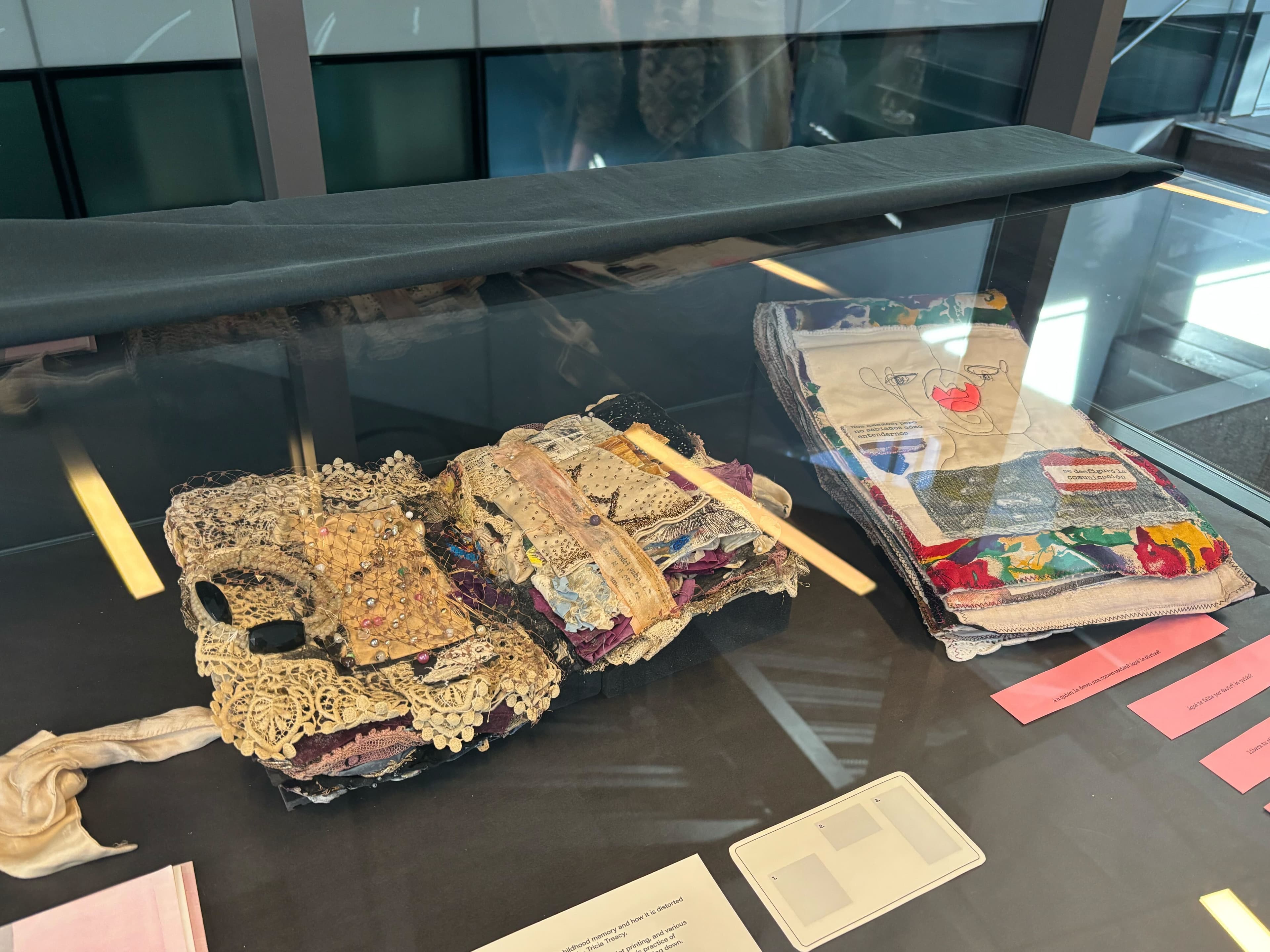
Amelie Pak’s “Remembering” is the latest exhibition to open with Bowes Art and Architecture Library’s student exhibits program. Conceptualizing memory in five chapters, “Remembering” questions the human inclination to document, how remnants invoke, what resonates, and what is erased.
A coterm in her third year pursuing her master’s in the Program in Modern Thought and Literature, Amelie notes that while the exhibition went through many permutations, what was core to “Remembering” was the realization that “librarians are stewards of objects.”
“What moved me was how Bowes’ librarians spoke about each and every object in the archives,” she shared. “So, ‘Remembering,’ being about objects that speak to how memories materialize, functionally reminded me just how salient having research-forward conduits of access—our librarians—are in knowledge spaces.”

Librarian Katie Keller recalls the origins of the program, which began in spring 2021 with a fashion history class’s visit to the library’s Locked Stacks. After an examination of an early 20th-century collection of French fashion journals and a crash course on exhibit display and conservation methods from the Stanford University Libraries’ head of preservation and Deardra Fuzzell, then the Special Collections exhibitions coordinator, the fashion history course culminated in a daylong show spotlighting student work.
From here, plans for a rotational exhibit program started to take shape.
Art librarians sent out a call to the fall 2022 cohort of students in art history, film, and media studies, inviting them to explore and work with the Bowes’ Locked Stacks collection. The response was overwhelming. Now in its fifth year and led by Keller, Bowes’ student exhibits program features a different show each academic quarter. Faculty and staff have also proposed ideas for their own exhibits, expanding the program’s original intent of encouraging engagement with the collection's materials.
“We have so many amazing materials hidden away in the Locked Stacks, and it’s great to see researchers making their own discoveries and synthesizing what they’ve learned for exhibit viewers,” says Head Librarian Lindsay King.
Highlights from “Remembering” include Warmth by Alexa Gross, eight woven gloves exploring matrilineal lineage and intergenerational memory, and Gloribel Delgado Esquilín’s Tanto Sin Decir (So Much Left Unsaid), a textile book made of the artist’s mother’s clothes that pieces together the painful silences of a mother-daughter relationship.

Marci Kwon, Associate Professor of Art History and Marta Sutton Weeks Faculty Scholar in the Humanities, appreciates how the exhibits program “give students a special opportunity to do hands-on curatorial work.”
“They’re in charge of a lot of the decision-making when putting together the cases,” Kwon explains. Her research and teaching address similar themes between the interaction of fine art and vernacular practice, discourse of “folk” and “self-taught” art, and Asian American/diasporic art. She co-directs Stanford’s Asian American Art Initiative and sees parallels in her own work, “[The program is] a real chance to put their art history knowledge into practice.”
Amelie’s exhibit will be running through June 4, 2026 at the Bowes Art & Architecture Library, located on the second floor of the McMurtry Building. Please bring a valid student ID to access the library; visitors must register on-site with a valid government ID card.
The program’s next exhibit, “Electric Contrasts: The Art of the Detail,” will be curated by Altair Brandon-Salmon, a lecturer in COLLEGE (Civic, Liberal, and Global Education) program.