SUCHO and Ukrainian Library Association Receive Karl Preusker Medal
The award recognizes the resilience of Ukrainian libraries, culture, and education in times of war.
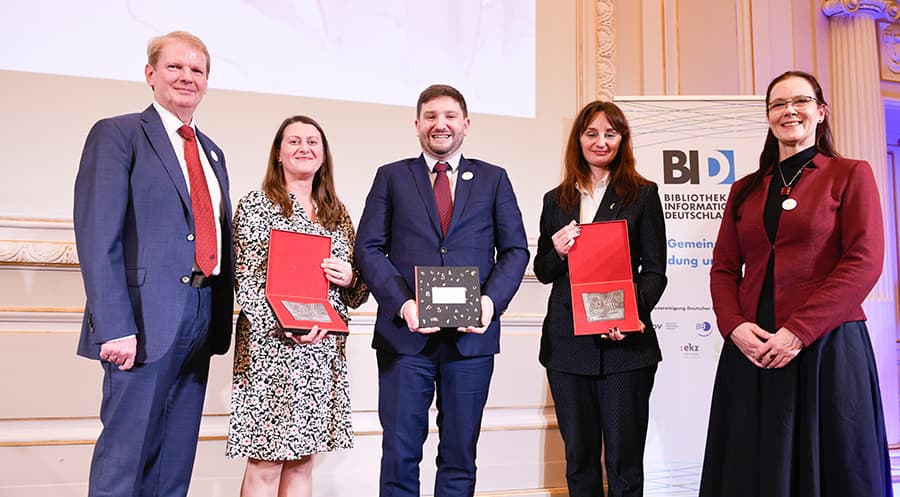
The Ukrainian Library Association and Saving Ukrainian Cultural Heritage Online (SUCHO) – an international data-rescue effort co-led by staff at Stanford University Libraries – have jointly received the Karl Preusker Medal, one of the most prestigious honors in the library world.
“The dedication of librarians at large, along with the proactive efforts of some here at Stanford University Libraries, played a crucial role in preserving the content of Ukrainian cultural websites that might otherwise have been lost,” said University Librarian Michael A. Keller. “It is worth noting that while the award recognized an entirely digital project, its success was fundamentally rooted in human responsiveness.”
Established in 1996 in honor of the founder of Germany’s first public library, the Karl Preusker Medal is awarded annually by the Federal Union of German Library Associations to individuals or institutions that have rendered outstanding service to librarianship. In announcing the award, the organization also reaffirmed its special assistance for Ukrainian librarians who have been forced to flee the country and called on Russia to comply with international wartime conventions protecting cultural property. This includes safeguarding libraries as “places of shelter and refuge” which uphold “the right to critical, democratic, free, and objective thinking and activities.”
Oksana Bruy, President of the Ukrainian Library Association, estimates that more than 1,000 library buildings and over five million volumes have been destroyed or damaged during the war. “These difficult times have shown that the library community has no borders,” Bruy said in remarks delivered remotely at the award ceremony in December at the Berlin State Library.
SUCHO was launched just days after Russia’s full-scale invasion of Ukraine in 2022. The initiative brought together more than 1,300 volunteers worldwide to create web archives of Ukrainian cultural heritage institutions. To date, SUCHO has preserved over 50 terabytes of data from more than 5,400 websites. While many organizations have long focused on protecting physical cultural materials during wartime, SUCHO was distinctive in its focus on digital cultural heritage, an area that has expanded rapidly through digitization efforts and as people share their lives online.
The project is co-led by Quinn Dombrowski, Academic Technology Specialist at Stanford University Libraries for the Division of Literatures, Cultures, and Languages (DLCL), alongside Anna Kijas (Tufts University), Andreas Segerberg (University of Gothenburg), and Sebastian Majstorovic (Data Rescue). “From the beginning, the project took an expansive view of cultural heritage,” said Dombrowski. “It included not only museums, libraries, and archives, but also community centers, fan fiction collections, and children’s after-school programs that document the cultural life of Ukraine before the war through pictures and written records.”

Graduate students in Stanford’s Slavic Languages and Literatures Department played a significant role in the endeavor. Georgii Korotkov pored over documentation for a widely used early-2000s Russian library catalog system to develop a scraper that captured Ukrainian library holdings before physical damage occurred. Alyssa Virker initiated an ongoing project to archive and analyze TikTok videos that reference Ukrainian poetry as a form of wartime commentary.
Staff also contributed key expertise. Ed Summers of Digital Library Systems and Services assisted with troubleshooting the open-source Browsertrix software used for distributed web archiving. Simon Wiles of Research Data Services continues to collaborate with Anna Rakityanskaya of Harvard University to maintain and expand the SUCHO Meme Wall, which preserves a widely shared yet ephemeral form of cultural expression. Each image is translated and annotated, creating a resource for future historians studying how Ukrainians, both within the country and across the diaspora, communicated their experiences and perspectives on the war’s ongoing trajectory.

“As far as we have been able to determine, Saving Ukrainian Cultural Heritage Online is the first attempt to do large-scale web archiving during an ongoing war,” Dombrowski noted in an interview published during the project’s most intensive archiving period in 2022. Prior to receiving the Karl Preusker Medal, SUCHO was honored with the Europa Nostra Cultural Heritage Champions Award in 2023 and recognized by a resolution from the Society for American Archivists in 2022. SUCHO alumni are now engaged in follow-up initiatives, including a zine on do-it-yourself web archiving, to share the lessons learned from this unprecedented effort.