Women’s Railroad Blues (Sorry But I Can’t Take You)
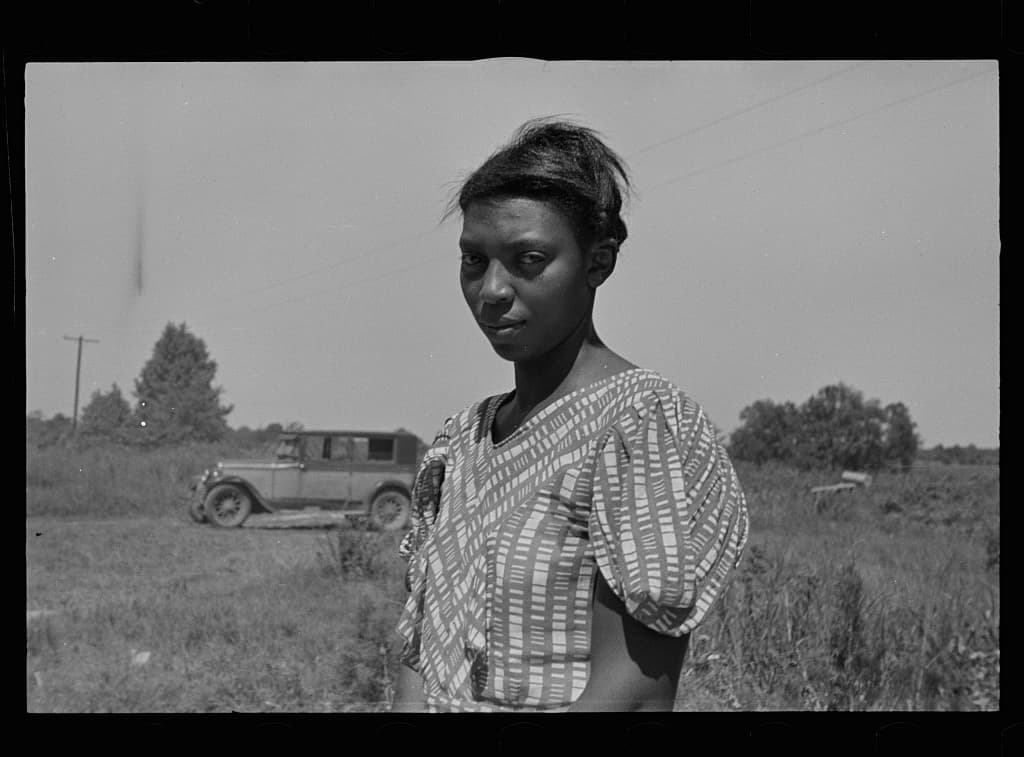
“To the women, the train was an unslayable monster,
a demon who swallowed up their men, who
usually didn’t come back and seldom sent for them”
(Rosetta Records)
The railroad defined American identity—the endless expansions, the technological advances, the sweat and tears—but the railroad also defined the Blues. According to national folklore, self-proclaimed Father of Blues W.C. Handy encountered Delta Blues while traveling the Yazoo-Delta Railroad line across Mississippi: “As I nodded in the railroad station while waiting for a train that had been delayed nine hours, life suddenly took me by the shoulder and wakened me with a start. A lean, loose-jointed Negro had commenced plunking a guitar beside me while I slept. His clothes were rags, his feet peeped out of his shoes. As he played he pressed a knife on the strings of the guitar in a manner popularized by Hawaiian guitarists who use steel bars. The effect was unforgettable. His song, too, struck me instantly. ‘Goin’ where the Southern cross’ the Dog.’ The singer repeated the line three times, accompanying himself on the guitar with the weirdest music I had ever heard. The tune stayed in my mind” (Handy et al.). From there Handy began to publish Delta Blues, establishing the genre across the U.S., solidifying the image of a solitary man with a guitar jumping from train car to train car in the public imagination.
But this American imaginary failed to see the Black women often left behind at the station. Compiled in 1980 as a part of a series of Rosetta Record’s “Women Heritage Music Records”, Sorry But I Can’t Take You – Women’s Railroad Blues is a mix of blues songs from 1923 until 1942. For many Black people in the American South, the railroad represented freedom not afforded to their mothers and grandmothers. According to US historian Barabara Welke, the open railroad offered men an opportunity to escape, to explore larger cities like Chicago and New York in the early ’20s. In the North, women’s jobs like seamstresses, domestics, and caretakers were not readily available, having been occupied by White immigrants. Men had an economic freedom that took them away from the South. Even if they were unable to afford a ticket, men were often provided the opportunity to be roaming vagabonds. The freight train was a man’s escape, for he could hop from train to train to ride. A woman could not (Welke).
Blues tends to be defined by its sad lyrics and slow, finger-picked guitar line but by the 1920s–1940s, when these songs were recorded, the style had grown. This record captures the genre merging with more rhythmic, big-band swing styles. I recently learned that Blues singers sing “blue notes,” —typically the 3rd, 5th, and 7th degrees of the scale. Bending these tones upward by a quarter tone or more, resulted in a vocal technique that echoed instrumental techniques heard on the fiddle, banjo, piano, or guitar (Library of Congress).

Throughout these songs you can hear the places where the instruments mimic not only each other but the singers and the sounds of the train. In many of the songs, such as Martha Copeland’s “Mr. Brakeman, Let Me Ride Your Train,” the actual sounds of the train are included—the screeching of an iron wheel on track, the scream of steam through a whistle, and the constant droning bell. In songs that don’t include the actual train recordings, the instruments mimic a railway’s soundscape. A great example is Clara Smith’s “L&N Blues” with brass trumpets twisting around her distinct playful cadence, with an ever-chugging piano rhythm.
I was a bit confused about how the compiler chose these songs and how she wove them together in this album. Some songs are repeated, with different versions placed side by side, presumably to encourage comparison and contrast. The songs aren’t in chronological order, or really any order that I can discern. On the inside cover there is a very detailed description of all the songs and their singers.For those of you who, like me, struggle to keep all the songs straight, I’ve written down a few personal highlights from the album below. Although many of the songs are on Spotify under their respective artists, multiple songs and recordings are only accessible in this collection:
The A Side:
Trixie Smith, "Freight Train Blues"
This song defines the album. It’s slow and represents a woman’s yearning for a man who won’t be coming back. “Mean old train that took my man away from here”
Clara Smith, "L&N Blues"
A playful change of pace. The instrumentals mirror her singing, the brass and piano sounds both like weeping and the train machinery itself. Her lyrics are personal and playful, she's poking fun through the sorrow. “If I ain’t riding I ain’t satisfied / I am a rambling woman I’ve got a rambling mind.“
Bertha Chippie Hill, "Panama Limited Blues"
Bertha’s voice is the standout. Her song is bright, loud, and purposeful, weaving in between a jazzy, lazy accompaniment. You won't forget what she's saying or the way she says it. “My Daddy left me standing and left me standing in the dust.”
The B Side:
Martha Copeland, "Mr. Breakman, Let Me Ride Your Train"
This is a standout song that includes a fun prelude. Full of whistles, what seems like a recording of a real train and her, perhaps, talking to the conductor. I’m not sure how they swung that in 1927 but it's a fun, fun song! Throughout it she is bartering and begging the conductor to let her on. “Please don’t put me on the shelf, If you do I’ll kill myself.”
Blue Lou Barker, "He Caught That B&O"
Blue has such a fun sharp, high voice—it's almost nasally and girly but with such a swinging resonance it sounds similar to a church band. She elongates her words in a slinking pattern.“Youuuu weep and worry, your lifeeee won’t last long”.
Sister Rosetta Tharpe - This Train
Sister Tharpe was known for using an electric guitar in her spirituals and you can hear the early beginnings of that here. This song has a bopping, strumming, upbeat circular melody. She begins to finish the collection. “This train don’t pull no liars, so you got to get off”.
Despite a limited number of different singers and songs, this album is an incredible archive, capturing a place in time where Black Women transformed their sorrow and anger into genre-defining art. The interior blurb written on the inside of the album does a beautiful job of exploring the history of the trains themselves, the recurring themes in the lyrics, and the lives of the singers. Born of a moment in which Black women’s songs and stories were not valued, this album provides a rare record of their voices—their longing, resistance, and humor in their own melodies. W.E.B Dubois notes on these songs, the blues, the grandchildren of enslavement, “...the past South, though it rose from the dead, can gainsay the heart–touching witness of these songs.” (Dubois, 1904). While these songs have long been interpreted as lovesick, longing songs for a man, if you really listen they aren’t songs about being left but rather a deep desire to ride away.
“I hate to hear that engine blow, boo hoo.
I hate to hear that engine blow, boo hoo.
Everytime I hear it blowin’, I feel like ridin’ too.”
Watch and listen to Sister Rosetta Tharp perform “This Train.”
Further reading
- Handy, W C, et al. Father of the Blues : An Autobiography. Boston, Ma, Da Capo Press, Middletown, De, 2017.
- Du Bois , W. E. B. “Chapter 14: Of the Sorrow Songs | the Souls of Black Folk | W. E. B. Du Bois. Chicago: A. C. McClurg and Co.
- Library of Congress. “Blues | Popular Songs of the Day | Musical Styles | Articles and Essays | the Library of Congress Celebrates the Songs of America | Digital Collections | Library of Congress.” Library of Congress, Washington, D.C. 20540 USA, 2025.
- Welke, Barbara Y. “When All the Women Were White, and All the Blacks Were Men: Gender, Class, Race, and the Road to Plessy, 1855-1914.” Law and History Review, vol. 13, no. 2, 1995, p. 261.
Hawthorn Bolger Witherspoon (‘26) is majoring in human biology with a concentration in community health.
This article is part of a series highlighting albums in Stanford’s Dijkstra Black Music Collection. The series was written by students in Music 147U: Identity, Difference, Sound, under the supervision of Ioanida Costache and John Fath. We are grateful to Nathan Coy, the entire ARS staff, Ray Heigemeir, Tamar Barzel, and Rochelle Lundy for their support of this work.