Archivists for the Dianne Feinstein Senatorial Papers release four record groups
The first materials available for in-person teaching and research include the manuscript of Senator Feinstein’s unpublished autobiography.
Stanford University Libraries, the designated repository of the Dianne Feinstein Senatorial Papers, has made available four record groups—Memorabilia, Photographic Materials, Press Relations, and Lyon Street House Materials—for in-person teaching and research. Senator Feinstein’s papers constitute one of the largest collections at the Libraries, encompassing over 7,000 linear feet of analog records, more than 3,000 memorabilia and photographic items, and approximately five terabytes of digital material, primarily related to her career as a United States Senator representing California from 1992 to 2023.
The ongoing project is funded by a $2.5 million Secretary of the Senate’s Preservation Partnership Grant, administered by the Senate Historical Office. This program strengthens the ability of repositories nationwide to process and provide access to senators’ papers. In addition to acquiring and preserving her senatorial papers, Stanford University Libraries holds the Dianne Feinstein early career papers, covering the years 1955 to 1994, and records in University Archives from her time at Stanford, where she was elected student body vice president and graduated with a Bachelor of Arts degree in History in 1955.
The processing team, led by Rebekah Valentine and comprising archivists Tiana Taliep, Cali Vance, Queenie Don, and Sabrina Gunn, has developed a finding aid for the four record groups, complete with links to request the newly released materials for in-person study. Materials in the remaining record groups will be made available onsite as each group undergoes full processing. The team has also uploaded over 20,000 digital objects to SearchWorks, the Libraries’ online catalog, making them accessible to everyone.
The Memorabilia Record Group consists of 3D items, photos, legislation, and other materials that Senator Feinstein displayed on the shelves and walls in her offices in Washington, D.C., and California. There are pins, posters, patches, newspaper articles, medals and awards, drawings, invitations, certificates of election, and red lines (signed copies of an enrolled bill or resolution), along with various trinkets from her fifty-plus years of public service. These items come from California organizations, national groups, foreign entities, and friends and family of the senator. All certificates of election, red lines, and Feinstein’s drawings have been digitized and can be viewed online. A selection of other memorabilia items has also been digitized. For an immersive experience, viewers can take a 3D tour of Senator Feinstein’s Capitol “hideaway” office and Hart Senate Building office.


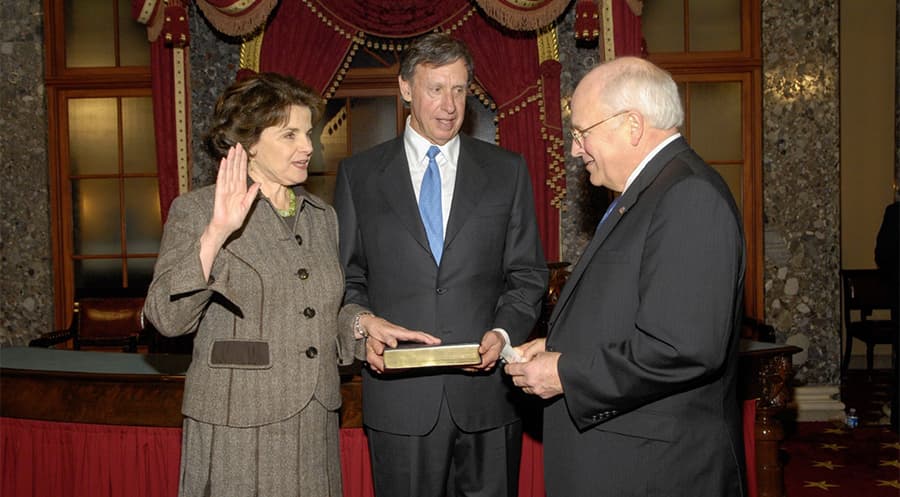
The Photographic Materials Record Group includes prints, negatives, slides, albums, and scrapbooks. While the majority of the photos depict Senator Feinstein in her role as California’s senior senator—at committee hearings, press conferences, constituent events, and with various dignitaries and Congress members—the collection also features images from her earlier career on the San Francisco Board of Supervisors and as Mayor of San Francisco. The negatives and slides complement the photographic prints and include cherished images from her family vacations. Five albums and scrapbooks, created by Senator Feinstein or her staff, highlight her achievements and milestones throughout her career.


The Press Relations Record Group contains materials related to the communications and public relations efforts managed by Senator Feinstein’s press office. This collection includes press releases, press clips, op-eds, events and speeches, press pamphlets, and memos annotated by Senator Feinstein, referred to in her office as “back from DFs.” The memos document her approvals and revisions of press releases, social media posts, and talking points. The op-eds were either written or co-authored by Senator Feinstein.
Lastly, the Lyon Street House Materials Record Group was established after the processing archivists gathered materials from Senator Feinstein’s residence on Lyon Street in San Francisco. Most of these materials, collected from the first floor of the house and her personal permanent display on the lower level, pertain to her tenure as San Francisco Supervisor and Mayor. The memorabilia from the Lyon Street house include commemorative medallions and coins, campaign pins, and ceremonial keys. Of particular interest are her art supply bag and a journal of her artwork and writings during her campaigns for California Governor and U.S. Senator. The bulk of the photos depict her speaking at press conferences, attending constituent events, interacting with various individuals, and traveling abroad as Mayor of San Francisco.


Of special interest to researchers and historians, the Lyon Street residence also housed an extensive audiovisual archive of campaign commercials, interviews, election debates, speeches, and swearing-in ceremonies, along with related campaign and political documents. The manuscripts from the house include drafts and revisions of chapters from Senator Feinstein’s unpublished autobiography, as well as her research materials and correspondence with publishers regarding the book.
This article is the fifth in a series about the Dianne Feinstein Senatorial Papers at Stanford University Libraries. More information about Senator Feinstein’s life and careers can be found on the Spotlight Exhibits website. Please direct all inquiries to: specialcollections@stanford.edu
Prior Articles
- “Late Nights with Senator Dianne Feinstein,” January 2026
- “From Draft to Distribution: Senator Dianne Feinstein’s Digital Press Releases,” November 2025
- “The Dianne Feinstein Senatorial Papers,” August 2025
- “Senator Feinstein’s Career in Photos,” April 2025