Big Local News helps local newsrooms ask bigger questions about rural schools through data
Grassroots journalism reveals national educational challenges from local perspectives.
Journalists representing six nonprofit newsrooms have published the initial round of a four-part series that examines the challenges confronting rural schools and the advantages they offer to their communities. Their locally sourced articles contribute to a collaborative reporting project developed by the Institute for Nonprofit News’(INN) Rural News Network (RNN), supported by a grant from the Walton Family Foundation.

Big Local News, based in the Department of Communication at Stanford University, gathered data to identify patterns and uncover newsworthy events related to rural schools. By providing this dataset to newsrooms, along with training on cleaning and using it, the project empowered the journalists to place their local stories in a national context. The Stanford Digital Repository, an open-access resource established by the Stanford University Libraries two decades ago, will archive the dataset.
In a report for INN, Rural News Network Editor Alana Rocha summarized the findings to date: “They [rural schools] can be gathering places, polling sites, food pantries, emergency shelters, health-care access points, sports facilities and sources of childcare. They can be among the largest employers in town. And when a school closes or districts consolidate, the consequences can reach far beyond where students attend class.” Rocha recently participated as a panelist in a Hoover Institution symposium on domestic rural life and institutions.
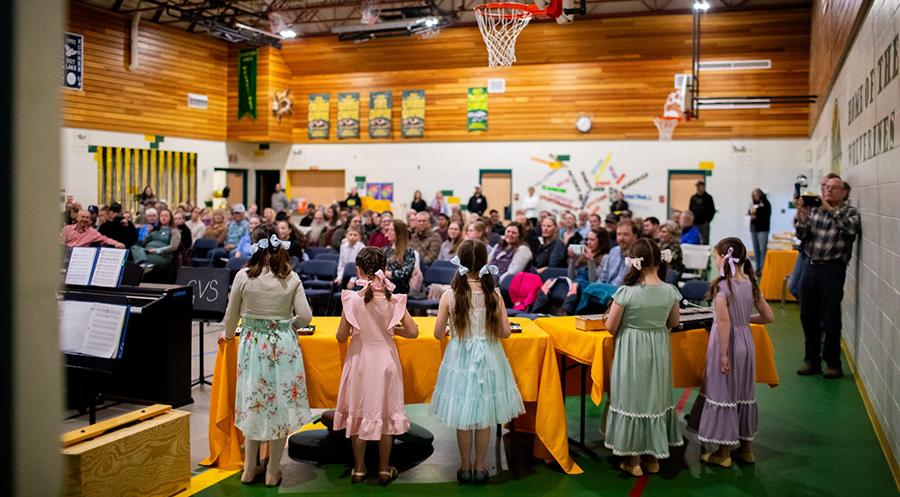
The project, titled “Common Ground: What Rural Schools Mean to Communities,” explores the evolving role of schools amid challenges such as limited resources and funding delays. Many rural school districts lack access to essential human services due to the absence of nearby medical facilities or community centers. However, these challenges are not universal, as each rural community experiences a unique set of circumstances and needs. Some schools face consolidation pressures caused by declining enrollment, while others are overwhelmed by rapid population growth resulting from families relocating from urban areas.
By leveraging the expertise of data specialists, Big Local News can partner with journalists—regardless of their geographical distances—to transform intriguing datasets into collaborative multi-newsroom reporting projects. The Big Local News website also offers reporting recipes that provide localized data and a guide for newsrooms and journalists interested in producing data-driven accountability stories.

Cherry Salazar, a data journalist at Big Local News, remarked, “Finding a dataset that quantifies the significance of rural schools was a challenge, so we used data as a contextual layer for these different stories. A small rural school may look like an anomaly in the data, but it may be one of few things holding a community together.” Salazar investigated similar issues at Civic News Company, parent of public education-focused nonprofit newsroom Chalkbeat. She was previously an investigative reporter and documentary producer at the Philippine Center for Investigative Journalism and ABS-CBN Corporation, the Philippines’ largest media network until it was forced off the air by the Duterte administration in 2020.
Danielle Gensch, the librarian for state, local, and international government information at Stanford, assisted Salazar in generating and refining the rural schools dataset and will direct its placement into the Stanford Digital Repository. “Government data is vital for our researchers and partners, including Big Local News, although access has recently become complicated due to changes in federal funding and actions,” said Gensch. “There was no single source for nationwide information on rural school district building usage, so we had to think creatively about how to leverage existing resources, such as the National Center for Education Statistics, state and local departments of education, and the National Rural Schools Association.”

“The first round of reporting is now published, taking readers from remote ranch country in California to Minnesota’s Iron Range, an Ohio college town, Alaska’s Mat-Su Valley, the Mississippi Delta and Southeast Texas,” said Rocha in the previously mentioned report. “For these newsrooms, the collaboration isn’t replacing that local knowledge. It’s giving them additional tools to dig deeper into questions they are already uniquely positioned to see. The data analysis from Big Local News is one of those tools. So is the ability to compare what is happening in one rural community with what is happening hundreds or thousands of miles away.”
Big Local News also provided data analysis for two widely circulated stories on school closures recently published by the Associated Press and the Hechinger Report. The stories explore the impacts of closures up close, looking at the experiences of affected communities in Vallejo, California.

Additional resources for studying rural schools are available within the holdings of social sciences and government documents at the Cecil H. Green Library, as well as in the curriculum collections at the Cubberley Education Library. Historical materials, including The Richard L. Venezky Collection of 19th and 20th-century American primers and readers, can be found in Special Collections.