The evolution of the Stanford Geoscience Specimen Collection
The historic collection is being revitalized through archival processing and is expanding its scope to include environmental studies.
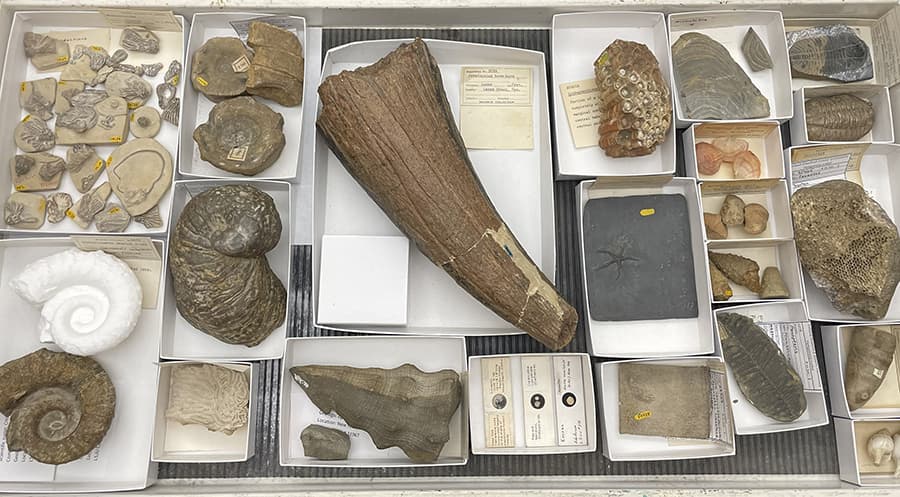
The Stanford Doerr School of Sustainability and the Stanford University Libraries are collaborating to reorganize, rehouse, and revitalize the Geoscience Specimen Collection, which contains an estimated half a million specimens, including rocks, minerals, fossils, cores, soil, water, and other physical materials. This impressive collection features awe-inspiring specimens obtained through deep-sea dredging and the ascent of remote mountains. It includes some of the earliest and most dazzling substances found in California, such as the state’s official mineral, gem, and rock—benitoite, gold, and serpentinite—along with lithium-bearing minerals from Southern California and sandstone used in the construction of the Stanford Quad, sourced from a long-closed quarry in San Jose.

“The library system functions as an archive, after all, and rocks are essentially our books. The collection had fallen into disarray, so I am delighted that the collection and curation managers from the Libraries are reordering it and making it more accessible,” said Stephan Graham, the Welton Joseph and Maud L'Anphere Crook Professor of Applied Earth Sciences and a member of the collection’s faculty advising committee. “Our knowledgeable staff is prepared to conserve and catalog Stanford’s diverse departmental collections, having managed everything from ancient coins and antique piano rolls to modern photographic prints. Yet, nothing compares to the age of these geoscience specimens,” added Michael A. Keller, the Ida M. Green University Librarian.
Chrissy Garcia, the Geoscience Specimen Collections Curator and Manager at the Libraries, oversees the project. “The collections program has been relaunched and is much more than just a historic collection; it is an actively used and continually expanding resource driven by Stanford research,” Garcia stated. Garcia, who came to the Libraries from the California Academy of Sciences in 2022 where she served as the Geology Collections Manager in the Institute for Biodiversity Science and Sustainability, leads a team of one full-time staff, three part-time staff, and several student assistants who provide research and teaching support to faculty, students, and visiting scholars.

This year, over twenty courses—primarily from the Stanford Doerr School of Sustainability—incorporated the collection into lectures or labs, or visited the physical collection space for an overview. Additionally, the mineral collection on display outside of Branner Library is frequented by the Geokids program which serves second grade students from local schools.
Rising senior Anneka Steen shared, “My major in Earth and Planetary Sciences and minor in Classics both stem from a love of piecing together a picture of what the world was like in the past—where, in the first case, the pieces are fossils and geochemical proxies, while in the second, they’re artifacts and literary sources. Working in the Geoscience Specimen Collection since my freshman year has helped me realize my interest in becoming a curator, and I want more of the Stanford community to know about this wonderful collection.”

Utilizing Stanford specimens alongside others borrowed from the California Academy of Sciences, Steen developed an exhibit focused on kelp forest ecosystems, currently on display in the Geology Corner. “Kelp is an ecosystem engineer, which means that where it grows, it shapes its environment into a specific type of habitat,” her exhibit illustrates. It showcases both living and extinct organisms that frequented kelp forests for the past 14-30 million years, including the hippo-like Desmostylian fossil, Neoparadoxia repenningi, uncovered in 1964 during the excavation for the Stanford Linear Accelerator Center.

Over 130 years in the making, the Geoscience Specimen Collection has been enriched by notable figures from Stanford's history, including David Starr Jordan, John Casper Branner, James Perrin Smith, and Herbert Hoover, as well as significant excavations like those for the Panama Canal. Stratified rocks over three billion years old, collected and studied by Donald Lowe, the Max Steineke Professor in Earth Sciences, Emeritus, provide crucial evidence of the impact of giant meteorite collisions on early crustal development and contain some of the earliest indications of living organisms within the collection.
“Pioneering women in the field have also made meaningful contributions to the development of the collection,” Garcia pointed out. Myra Keen volunteered during the Great Depression to catalog seashells and fossils under the guidance of Ida Oldroyd. She gained such extensive knowledge from her work that she became a leading authority on marine molluscs and was often called “The First Lady of Malacology”. She became professor of paleontology at Stanford in 1954. A decade later, Judy Terry Smith was one of the first three women permitted to attend Stanford’s Summer Field Geology course. Mentored by Keen, Smith established herself as an invertebrate paleontologist, celebrated for her research on fossil mollusks, particularly scallops, from Baja California, Mexico. Their stories are documented in an oral history interview conducted with Keen in 1977 by the Stanford Historical Society and in a video interview accompanying Smith’s profile on the Paleontological Research Institution “Daring to Dig” project website.

“With technological advancements, the research value of the archival collections is rejuvenated,” said Graham. “For example, we can now assign numerical ages to certain individual grains of sand. The results have been surprising and have transformed our understanding of the Earth and its evolution.” His research integrates both archival collections and ongoing field samples from Western China, Mongolia, and Patagonia, bringing several tons of rock and sand into the collection. Dr. Zachary Sickmann, a sedimentologist at the University of Texas at Dallas and a former student of Graham’s, has demonstrated that sand dating technology can identify instances of sand piracy in regions where it is in short supply for use in cement and concrete. “Thus, our research interfaces with a significant societal problem,” Graham added.

Many Stanford specimens are irreplaceable, having originated from locations that are no longer accessible due to political reasons, economic constraints, environmental challenges, or logistical issues. The National Science Foundation and other funding agencies now mandate the archiving of these samples and ensuring open access to them. The collection has expanded beyond geology to encompass environmental studies, requiring a cold room for ocean and soil samples that degrade with heat.

Graham cherishes the "AHA!" moment when non-majors in his introductory geology course hold a volcanic rock or dinosaur bone in their hands. “Seeing and touching the specimens is a vital aspect of learning about them and plays a crucial role in educating the public and providing outreach opportunities,” he stated. Highlights of the collection are on display in the first floor lobby of Braun Corner (Geology Corner) and at the entrance to the Branner Earth Sciences Library & Map Collections in the Mitchell Earth Sciences Building.