Honoring the retirement of Julie Sweetkind-Singer
Her leadership brought Stanford to the leading edge of geospatial studies and launched the world-renowned David Rumsey Map Center.
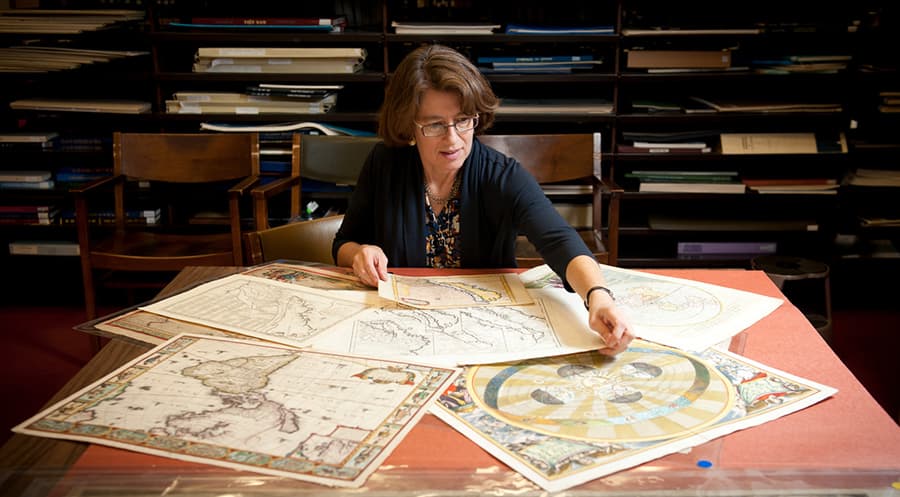
As we conclude this academic year, we take a moment to acknowledge the distinguished career and accomplishments of Julie Sweetkind-Singer, Senior Associate University Librarian for Collections and Public Services, who has announced her retirement, effective June 26, 2026. “After an impressive 26-year journey at Stanford University Libraries, Julie leaves behind a remarkable legacy that has profoundly shaped the Libraries' growth and the resources available to our community," said Michael A. Keller, the Ida M. Green University Librarian. “Her contributions have transformed the landscape of library services and collections, particularly in the areas of geospatial and mapping technologies,” he added.
Sweetkind-Singer began her tenure at Stanford in 2000 as the Geographic Information Systems and Map Librarian. Her passion for making geospatial data accessible led her to initiate transformative projects, including securing a California State Library grant that funded the cataloging and digitizing of historical materials from the Stanford Geological Survey. This three-year grant enabled the project team to make over a century's worth of student fieldwork, dating from 1895 to 1995, accessible to the public. This early undertaking set the stage for a career filled with innovative initiatives that have left a lasting impact on campus and beyond.

In 2004, Sweetkind-Singer was appointed Head Librarian for the Branner Earth Sciences Library & Map Collections, a position she held for over two decades. During her tenure, she spearheaded several groundbreaking projects, including the National Geospatial Digital Archive, a collaborative initiative with the University of California, Santa Barbara, funded by the Library of Congress's National Digital Information Infrastructure and Preservation Program. This five-year endeavor not only advanced Stanford's digital infrastructure but also fostered partnerships with national organizations, significantly enhancing the visibility and accessibility of geospatial data on a global scale. Ultimately, it resulted in the creation of the Stanford Digital Repository, with the first iteration designed specifically to house geospatial data.
EarthWorks, a geospatial search engine, was another significant initiative launched by Sweetkind-Singer. Originally designed as a pipeline to digitize public domain maps, the portal now offers nearly 60,000 spatial data layers with metadata from over a dozen institutions across the United States. Additionally, she oversaw the Japanese Military Maps project, a decade-long endeavor that cataloged, scanned, and created access points for nearly 10,000 captured gaihozu (“outer lands”) maps deposited at Stanford after World War II. The project's success has resulted in the establishment of the only extensive online archive of these maps in the world, the transfer of similar maps from the University of Tennessee, a conference hosted at Stanford that brought scholars from Japan, and an invitation for Sweetkind-Singer to speak in Kyoto, discussing digitization and discovery efforts for Japanese maps with library and museum professionals.
Sweetkind-Singer’s leadership was instrumental in establishing the David Rumsey Map Center, a collaboration with renowned map collector David Rumsey that has become celebrated for its profound impact on teaching and learning. With a diverse array of classes, exhibitions, conferences, and an extensive collection of digital resources, the center stands as a testament to her commitment to enriching academic inquiry and fostering a vibrant community centered on map and geography scholarship. Following David Rumsey's agreement in 2009 to donate his world-class collection of maps to Stanford, she worked closely with him, a large team of library colleagues, and outside specialists to design, construct, and staff the center, which officially opened in 2016.

During this time, she and Rumsey also envisioned the Digital Philanthropy Map Collections Project, which facilitated the borrowing and scanning of maps from noted collectors, resulting in tens of thousands of map images being added to the library catalog at a fraction of the cost of purchasing the original materials. Today, both the David Rumsey Map Center and the Stanford Geospatial Center are recognized as among the most vibrant and active areas of support offered by Stanford University Libraries.
“From the beginning, Julie has been an essential partner in building my map collection,” said David Rumsey. He added, “She was critical in realizing my vision of what the Rumsey Map Center should be: combining digital and analog maps and globes, freely accessible to all. More than a partner, Julie is a great friend, unfailingly kind and generous. Abby and I wish her the best in her next chapter.”
Ron Gibbs, Clinical Professor of Obstetrics and Gynecology at Stanford Medicine, serves as the President of the California Map Society, a longstanding partner of the David Rumsey Map Center in numerous endeavors. “It’s hard to think of a more appropriate name for Julie than ‘Sweetkind,’ as it epitomizes her perfectly. Alternatively, she could be called Julie ‘Organizer,’ Julie ‘Efficient,’ or Julie ‘Great Lecturer,’” Gibbs said. “In every interaction, whether as an officer of the CMS or as a map donor, I have found Julie to be collegial, warm, collaborative, knowledgeable, helpful, generous, and kind. Our members have enjoyed her many insightful presentations.”
In recent years, since her appointment in 2022 as Senior Associate University Librarian for Collections and Public Services, Sweetkind-Singer has played a pivotal role in managing the Library Materials Budget and overseeing nearly one hundred staff members across multiple branch libraries. Her adeptness at navigating budgetary challenges, combined with her efforts to cultivate a culture of collaboration and support among library staff, has set a standard of excellence at Stanford University Libraries. She has been recognized not only for her visionary leadership but also for her unwavering commitment to enhancing library services during challenging times, including her guidance to staff through the COVID-19 pandemic.

In 2023 and 2024, Sweetkind-Singer led the Stanford team in negotiating the acquisition of the personal archives of Kristine McDivitt Tompkins and Douglas R. Tompkins, as well as the archives of Tompkins Conservation, while also securing funding for a processing archivist. These materials, which pertain to their conservation and rewilding efforts in Chile and Argentina, will directly benefit students and faculty interested in field studies, land conservation, and the creation of national parks.
This synopsis can only highlight the remarkable peaks of an accomplished and endlessly fascinating career. A few additional noteworthy accomplishments deserve mention. Sweetkind-Singer was the first librarian ever appointed to the National Geospatial Advisory Committee, where she completed her six-year term as Chair. “Julie was an absolute delight to serve with during her tenure on NGAC,” said Ivan B. DeLoatch, former Executive Director of the Federal Geographic Data Committee. “Demonstrating the ability to navigate challenging and critical issues, Julie led the committee in a respectful and professional manner that produced numerous recommendations utilized by the Secretary of the Department of the Interior to help support and advance the geospatial community. Her perspective from the library community was both insightful and useful in many of our considerations.”
She has also served as a board member on the NASA Socioeconomic Data and Applications Center advisory committee, a member of the Board of Review for the Leventhal Map Center at Boston Public Library, and as President of the Western Association of Map Libraries. Recently, she negotiated an agreement with the Stanford Doerr School of Sustainability to jointly manage 500,000 specimens of rocks, minerals, fossils, and related materials. An accomplished author, she is widely published and was frequently invited to teach courses and deliver talks and keynote addresses, including a notable presentation in 2024 at the Herbert Hoover Presidential Library in celebration of Lou Henry Hoover’s 150th birthday.

Throughout her career, Sweetkind-Singer has consistently prioritized student and faculty engagement, creating countless opportunities for learning and connection. Professor of History Tom Mullaney stated, “Knowing and working with Julie over the past twenty years has been one of the highest honors of my career, and one of the highlights of my life. Julie is holistically good. A brilliant, thoughtful, caring, and decisive colleague. And as a person, a shining beacon of what we all aspire to be.”
Kären Wigen, the Frances & Charles Field Professor in History, said, “The annual tours of the Branner Map Library that Julie has provided for my classes since 2002 did more than introduce a steady stream of students to the riches of Stanford’s collections. They also educated this geographer-turned-historian about the steady stream of expansions in the university’s map holdings, the ever-increasing capabilities of map software, and a series of innovations across the whole range of cartographic librarianship.”
In her generosity, Julie Sweetkind-Singer has graciously offered to share her reflections on retirement with our readers: “I feel very fortunate to have been a member of Stanford University Libraries and to have played a part in its success over the last two and a half decades. I have been given nearly unlimited opportunities to create programs and provide resources in line with the research and teaching needs of our faculty and students. I was lucky enough to have supervisors, one after another, who understood my vision and supported it wholeheartedly. I’ve also been blessed with amazing, smart, and giving colleagues without whom my own success would never have happened. None of these accomplishments were solely at my own hand. They were in collaboration with talented co-workers who worked with me to accomplish great things.”