It’s all in the details
Bowes Library’s current exhibit looks at how juxtaposed details from familiar paintings can create new artistic meanings.
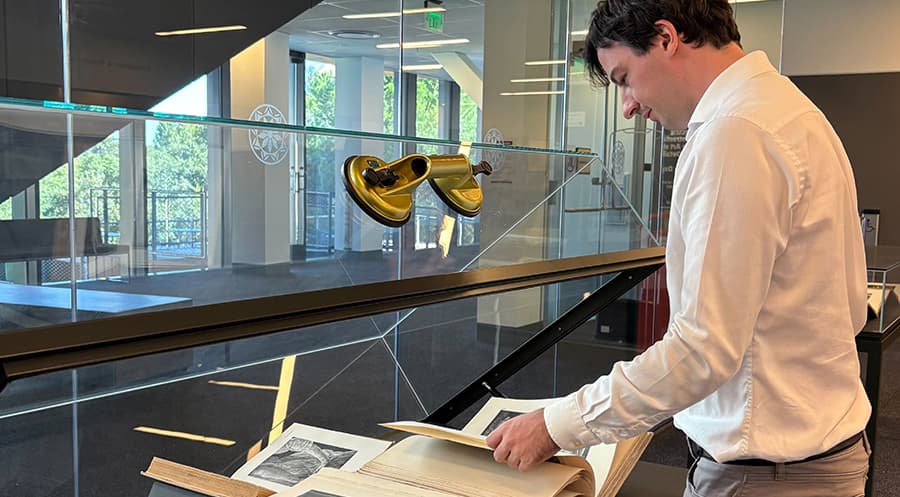
At first glance, the book spreads in the Bowes Art & Architecture Library’s newest exhibit, Electric Contrasts: The Art of the Detail, feature contrasting images. Botticelli’s Venus and Mars (circa 1485), cropped to reveal only Mars’ face in deep slumber, sits opposite two theater masks from Bronzino’s An Allegory with Venus and Cupid (circa 1545). These isolated details, removed from their original contexts and placed in conversation with each other, present an entirely new piece.
Altair Brandon-Salmon, who received a PhD in Art History at Stanford in 2024 and serves as a lecturer in the university’s Civic, Liberal, and Global Education program, conceived and curated the exhibit. He drew inspiration from One Hundred Details from Pictures in the National Gallery by Kenneth Clark, which he first encountered as a teenager while visiting the National Gallery in London. Clark’s book presents Old Master paintings as cropped, black-and-white pairs, significantly changing how art was viewed and consumed after its publication in 1938. “Likewise, the objects in the exhibit invite the viewer to think about the juxtaposition of the images on display,” Brandon-Salmon added.
“One Hundred Details anticipated, in ways that Clark could not have predicted, how the art of the Renaissance and Baroque periods would become beautiful ‘irreconcilable fragments of the past’,” Brandon-Salmon writes in the handout published for the exhibit. He proposed the exhibit concept while preparing a talk on Kenneth Clark at the Courtauld Institute of Art in London last winter, and collaborated on its design and installation with Katie Keller, an art librarian who had assisted him during his doctoral studies at Stanford. “We are delighted by Altair’s continuing involvement with the Bowes Library and anticipate that his exhibit will spark interesting conversations both within and beyond the library,” Keller said.

The exhibit’s title came to Brandon-Salmon when he was reflecting on how electricity and photographic technology impacted the ways in which the public interacted with art at the turn of the 20th century. “Most of the pieces I pulled for the exhibit are from the 1930s, a decade defined by neon light and photography and cinema. For example, the National Gallery installed electric lighting in 1935, allowing the museum to extend its hours into the evening, which made art more accessible to the public,” he said. The reproducibility of art is a persistent theme that runs through Electric Contrasts, made apparent in the avant-garde magazines and books selected for the exhibit.
Brandon-Salmon describes the curation process as a “self-conscious reflection on art.” One of his favorite pieces is La Psychologie de l’Art (translated into English as The Voices of Silence) by André Malraux. The three-volume book includes photographs of sculpture and artwork that were commissioned by Malraux and “is about how art affects the viewer through time,” he explained.

“I want viewers to come away with a sense of beauty for art books,” Brandon-Salmon says, “and to understand that they’re not just purely for academic interest.”
Electric Contrasts will be on view through December 18, 2026.
In conjunction with Electric Contrasts, the Department of Art & Art History will host a Study Evening event on Thursday, November 5. This event will feature a discussion between Geraldine Johnson, Associate Professor in the History of Art at the University of Oxford, and Alexander Nemerov, the Carl and Marilynn Thoma Provostial Professor in the Arts and Humanities at Stanford, moderated by the exhibit’s curator, Altair Brandon-Salmon.