More than directions
The David Rumsey Map Center’s newest student-curated exhibition explores the history of transit maps.
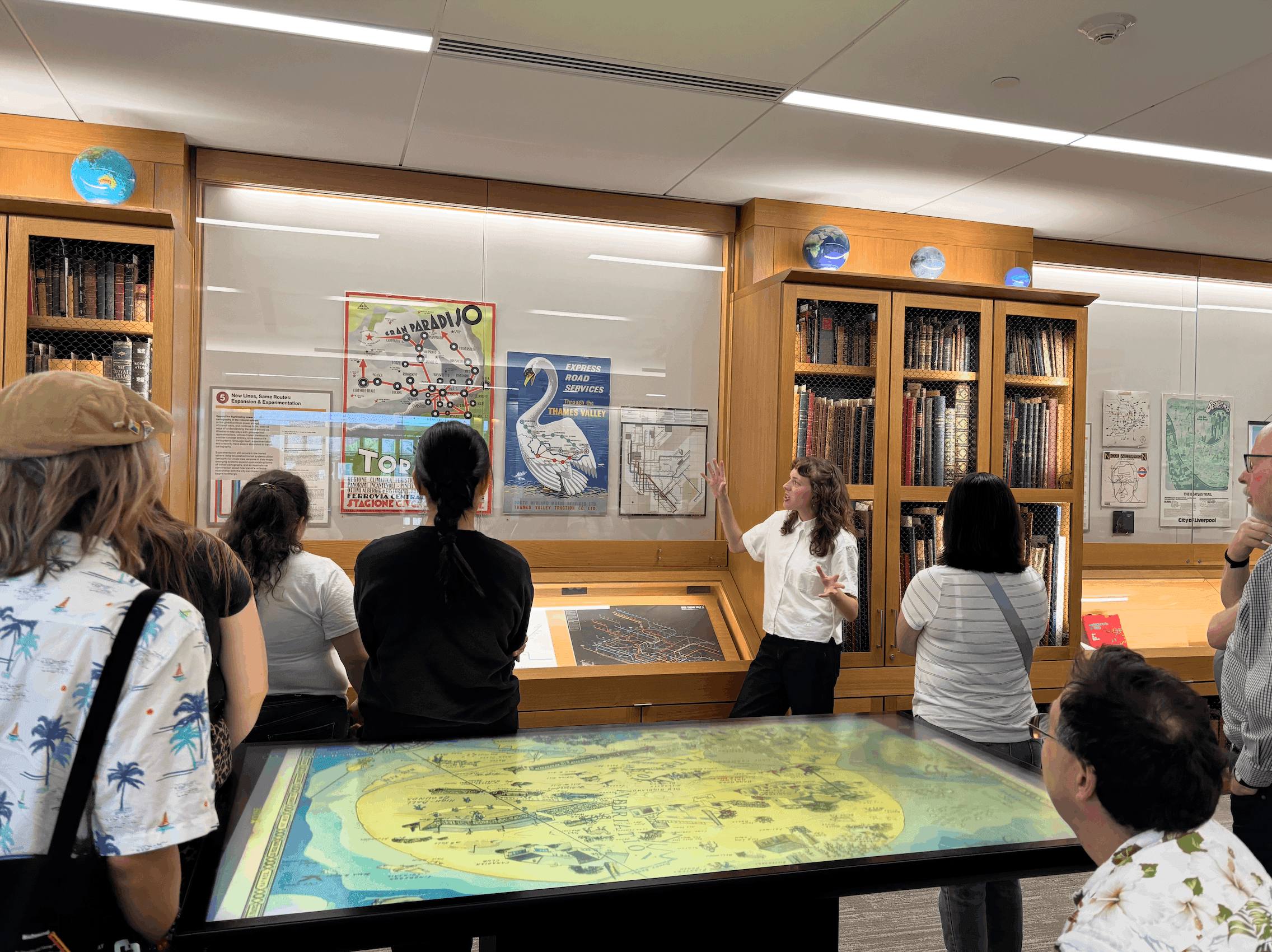
The winning exhibit of the California Map Society and David Rumsey Map Center’s fourth annual student map exhibition competition uses transit maps to bridge the past and present, telling the story of how cities and nations are transformed.
Curated by Jayne Kilander, a master’s student at the University of Wisconsin–Milwaukee, You Are Here: Transit Cartography & Spatial Identity explores the unique relationship between regional and global transit maps and the sociocultural identity of their subjects. The exhibit is organized into six sections, fittingly named “Stops,” and invites viewers to consider maps as cultural objects.
Kilander, who is pursuing a coordinated degree in Urban Studies and Library and Information Science, has long been fascinated by how public transportation systems are recorded. “My childhood home was across from a freeway entrance,” she shares, recalling the roots of her interest in railway maps. “When we moved in, the house came with a map of the neighborhood before the freeway was constructed.” Her interest was further sparked when she took a maps and historical resources course as an undergraduate. This subsequently led her to pursue an internship at the American Geographical Society Library (AGSL), which houses one of the largest map collections in the world.

It was through her internship that Jayne heard about the exhibition competition. She was selected as a finalist after submitting three maps for her initial proposal and then worked closely with the David Rumsey Map Center’s associate curator, Kristina Larsen, over the course of several months to create a fully developed exhibition packet for the next stage of the competition.
“Once I figured out what the sections of the exhibition would be, it became clearer what was most meaningful for me to show with the collection,” Kilander says. “It was interesting to see how cities and regions started to assert their self-dominance with transit systems, and what a city is when it becomes defined by its transit system.” One of her favorite maps featured in the exhibit, the Black History Tube Map, reimagines the Tube through the lens of Black history in London. Rather than station names, the map features the names of Black activists, artists, authors, and transportation workers who have contributed to London, and “creates a powerful narrative that shines light on place-based history.”

“The panel really responded to Jayne's wonderful selection of materials and the interesting angle she applied when analyzing the transformation of transit cartography precipitated by Henry Charles Beck's work for the London Underground in the 1930s,” Larsen says. “She chose beautiful maps to illustrate her thesis, and the story she tells is both accessible to people with no prior knowledge of the topic and sophisticated enough to be engaging to people for whom some of this material may be very familiar.”
“If we think about how transit lines are created, they’re not exactly created with everyone in mind,” notes Kilander. The ways in which mapping can empower or erase communities were a running theme during her presentation at the California Map Society Spring 2026 Conference, a “discussion that did not disappoint,” comments Ken Habeeb, the Vice President (Northern California) and Director at the California Map Society.
“By studying the legitimizing impact of established cartographic languages, we can start imagining new futures for the places we travel to and from,” Kilander adds. “And it’s fun to see how people interpret and reinterpret transit maps.”
You Are Here is on display in the David Rumsey Map Center until August 21, 2026. The exhibition is also viewable digitally.
Past winners
- “Spheres of Influence: Projecting Power & Fear onto the Globe,” Champ Turner (Brown University), 2024
- “Epicenters: Navigating Recovery and Renewal from Disasters,” Muhammed Dhafer (Stanford University), 2023
- “Mapping Spatial Scarcity,” Arjun Maheshwari (Stanford University), 2022