Piano rolls: bridging technology and musical expression
The Global Piano Roll Meeting at Stanford will announce the Pianolatron app, a new technology animating a historic musical medium.
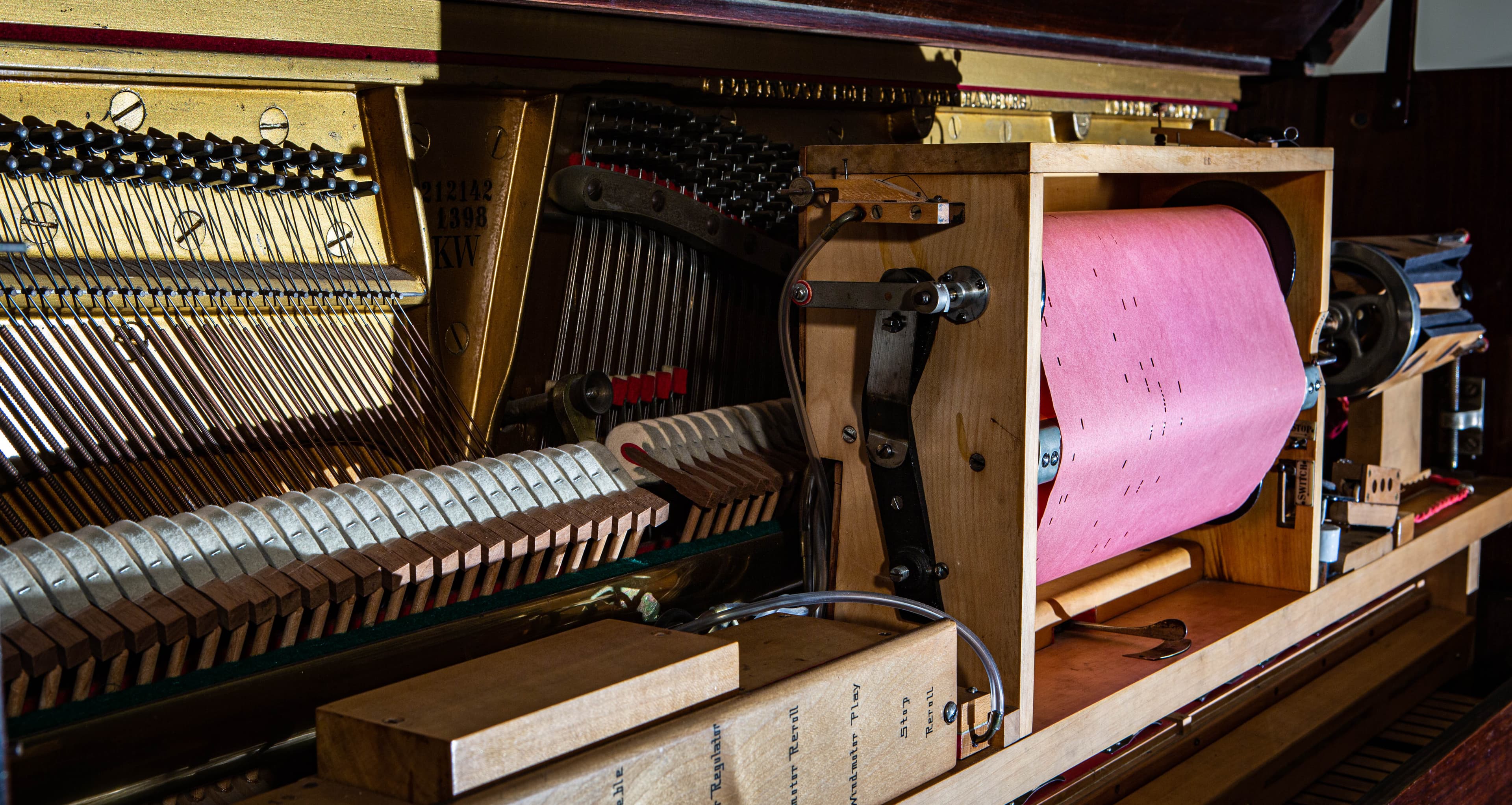
Piano rolls—perforated paper rolls designed for player pianos—were among the first commercially successful technologies to mechanically reproduce music, bringing self-performing pianos into living rooms and concert halls across the globe. Introduced in the late 1800s, player pianos and rolls were a major industry by the early twentieth century. Unlike Edison’s phonograph cylinders and the flat discs produced by Victor and Columbia, which captured sound directly, a piano roll mechanically encoded a piece of music, which a player piano then reproduced using an innovative vacuum system. Piano rolls maintained a dedicated audience alongside newer recording technologies for decades. They stand today as remarkable products of nineteenth-century mechanization with enduring cultural value.

On August 7–9, Stanford will host the fourth biennial Global Piano Roll Meeting (GPRM), the premier international forum for music roll scholars, performers, archivists, and enthusiasts. This marks the first time the event will take place in the United States, following previous gatherings at the Sydney Conservatorium, the Bern Academy of the Arts, and the Grassi Museum of Applied Arts in Leipzig.
The Stanford-developed Pianolatron app, led by principal investigator Kumaran Arul from the Department of Music and developed by Peter Broadwell and Simon Wiles from the Libraries’ Research Data Services, will be officially announced at the GPRM. Preliminary versions of the app were showcased at the Digital Humanities 2022 conference and exhibited at the Museum of Music Automatons in Switzerland. ”Many of us involved with piano rolls have dreamed of creating a sophisticated digital tool to analyze and engage with this complex medium,” explained Arul. ”With Pianolatron, users can see, hear, and actually play Stanford’s digitized rolls themselves. In addition to its research applications, it is also great fun.”

Pianolatron was inspired by the pianola, a player piano that allowed performers to control parameters such as speed and volume while a roll was playing. The app offers audio playback for Stanford’s scanned rolls in sync with a scrolling animation of their digital images. Supplemental animated graphics display a piano keyboard and pedals, also identifying each perforation with a color-coded overlay. There is on-the-fly control over multiple musical nuances, including tempo, rubato, dynamics, and accents, allowing anyone to create and record a web-based interactive performance of a digitized roll. This unique experience is freely accessible through Stanford’s online exhibit via a web browser on any modern computer or large tablet.
“Stanford University Libraries has been represented by multiple speakers at each biennial Global Piano Roll Meeting,” said Broadwell, Head of AI Modeling & Inference. This year, Broadwell will review the Pianolatron project’s trajectory and offer a methodology for sharing playable piano roll scans with the global community, while his colleagues Freja Cole and Kevin Kishimoto will propose a Wikidata-based collaborative model for archival description. Each day will conclude with concerts featuring the pianola, the playback of physical rolls on historic instruments, and interpretations of digitized rolls on a new Yamaha Disklavier piano, directed by the Pianolatron app.
Driven by faculty interest in the untapped research potential of historic piano rolls, the Department of Music and the Libraries collaborated to launch the Piano Roll Program (then the Player Piano Project) in 2014. The initiative established a research program while developing methods to preserve and catalog rolls, creating a database of digitized rolls, and ultimately designing applications to experience rolls online. “This incredible program brings together multiple units within the Libraries and has engaged interdisciplinary researchers at Stanford and beyond, including graduate students at the Center for Computer Research in Music and Acoustics,” said Vijoy Abraham, Assistant University Librarian for Research Data Services. ”Their work has made it possible for anyone in the world to study and enjoy Stanford’s piano rolls.”
The Denis Condon Collection of Reproducing Pianos and Rolls, a renowned Australian collection of rare instruments and rolls, was a flagship acquisition. More recently, the donation of the Robert J. Berkman Piano Roll Collection significantly expanded Stanford’s holdings of Jewish music and rolls geared to the tastes of early twentieth century immigrant communities. Currently the Archive of Recorded Sound at Stanford University Libraries holds over 20,000 piano and organ rolls, one of the largest library-based collections in the world, while the Music Department houses an exceptional collection of player pianos.
Music historians appreciate rolls for the insights they afford into the musical past. Stanford’s collection is especially strong in “reproducing rolls,” which capture performative nuances. Through these rolls, scholars of historical performance can analyze interpretations by renowned classical pianists and hear composers such as Debussy and Gershwin performing their own works. Rolls also provide unique historical context for the diverse repertoires and popular genres that bygone audiences favored, while “word rolls” and accompaniment rolls shed light on how music was learned, taught, and shared.
Playing rolls on original instruments is crucial to understanding how they were meant to sound. At the same time, many rolls today are too fragile or too rare to risk wear and tear from repeated use. With generous guidance from an international community of roll experts, Stanford commissioned a custom-built optical scanner and began digitally preserving these vulnerable artifacts. Developers from the Music Department and the Libraries created software to convert roll data to computer MIDI, which is then converted to audio files that emulate the sound of a well-maintained acoustic player piano. The paper roll is preserved in archival storage, and the music encoded on the roll can be heard again. All the files are free to download.

“The Piano Roll Program exemplifies our commitment to digitally preserving at-risk historical records stored on deteriorating media or accessible only through scarce or obsolete devices,” said Michael A. Keller, the Ida M. Green University Librarian. “Piano rolls themselves were once a technologically advanced medium for cultural conservation. Our program aims to ensure that these invaluable records remain open to future generations, safeguarding the rich interrelationship between music and technology—a goal we share with our esteemed guests at the Global Piano Roll Meeting.”
The GPRM is open to the public at no charge. To register and see the full program, go the Stanford Events listing for Day 1, Day 2, and Day 3.