Stanford acquires the Lawrence Weschler Papers
Weschler’s diverse body of work advances literary and journalistic nonfiction while exemplifying interdisciplinary research.
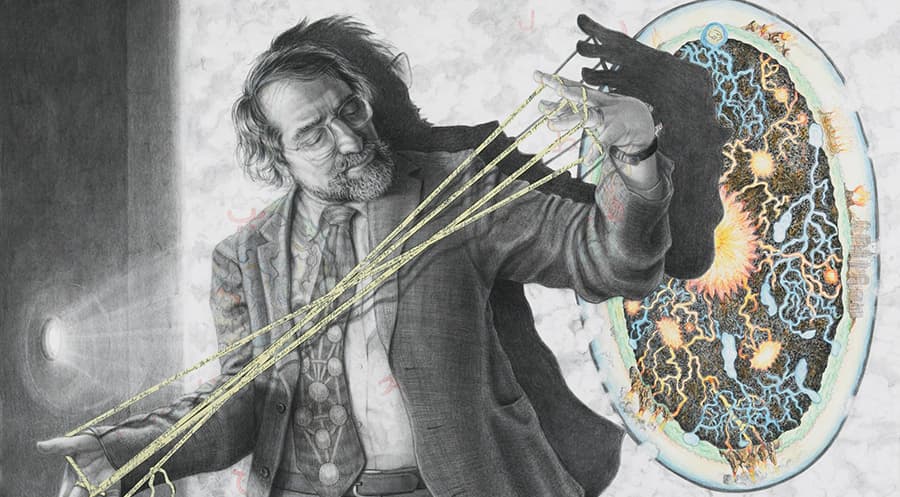
Stanford University Libraries proudly announces the acquisition and opening for research of the Lawrence Weschler Papers, a significant collection documenting the life and work of the celebrated nonfiction author. Spanning from the 1950s to the 2020s, this collection contains over 200 boxes filled with manuscripts, correspondence, research files, and teaching materials that illuminate Weschler’s distinguished career. Known for his more than two-decade tenure as a writer for The New Yorker and McSweeney’s, as well as his numerous essays in publications such as Harper’s, The Atlantic, and The New York Times Magazine, Weschler's work has played an influential role in shaping nonfiction. The papers are now processed and open for research, inviting scholars and students to explore the archives of one of the most influential voices in contemporary literature.
“Ren Weschler has been a central force in American letters, or at least, that part of it that clusters around The New Yorker. To have a chance to see how he developed his articles there and to gain a glimpse inside the magazine’s workings is very valuable,” said Fred Turner, the Harry and Norman Chandler Professor of Communication. “Much of my research focuses on ‘scenes’ — the loose clusters of folks whose writings, parties, and professional collaborations go on to change institutional worlds. Ren’s correspondence opens out onto the scenes that have driven the New York publishing industry in the last half of the twentieth century. This kind of material is often hard to find and important — for cultural historians, cultural sociologists, and anyone interested in America’s public life in this period,” added Turner.

Lawrence “Ren” Weschler, who was born in Van Nuys, California, in 1952 and graduated from Cowell College of the University of California Santa Cruz in 1974, is known for his diverse body of work on topics ranging from art and medicine to human rights and political transformations. Notable among his more than twenty books are Seeing Is Forgetting the Name of the Thing One Sees, a life of contemporary artist Robert Irwin; Mr. Wilson’s Cabinet of Wonder (on Los Angeles’s Museum of Jurassic Technology), a finalist for the Pulitzer Prize; and Everything That Rises: A Book of Convergences, winner of the National Book Critics Circle Award.Weschler also won the Lannan Literary Award and the George Polk Award twice. His writings reveal not only a dedication to accurate storytelling but also a profound compassion for the individual narratives behind significant events.
“Some years ago, I encountered Weschler’s book on Robert Irwin. It became formative for me, not only in helping me understand my own ideas about perception but also in my teaching,” said Alexander Nemerov, the Carl and Marilynn Thoma Provostial Professor in the Arts and Humanities. “In particular, I would often give a lecture for undergraduates linking the pure blue in Rogier van der Weyden’s Descent from the Cross to George Eliot’s Middlemarch, where she describes how our perceptions are necessarily muffled; otherwise, we would see and sense too much and ‘die of that roar which lies on the other side of silence.’ This connects to the magical clarity of perception Irwin describes upon emerging from an anechoic chamber.”

The Lawrence Weschler Papers also contain unique correspondence and unpublished materials from renowned figures. A notable subset dedicated to neurologist and naturalist Oliver Sacks documents the thirty-five years of their friendship (starting with seven years of intensive reporting leading toward a New Yorker profile, which at the time Sacks asked him to suspend though years later, on his deathbed, Sacks asked him to return to, culminating in the 2019 publication of And How Are You, Dr. Sacks?). Abraham Verghese, the Linda R. Meier and Joan F. Lane Provostial Professor, Emeritus, said, “Several boxes of Weschler’s notes, files, interviews, and correspondence with Oliver Sacks, with whom he shared years of friendship and professional collaboration, are of special interest to Stanford Medicine. His nonfiction writing demonstrates compassion for the individual human narratives behind world events, and his extensive research into wide-ranging subjects provides an important example for Stanford scholars in many disciplines.”
Weschler is known as well for his writing on the constellation of German and other European emigres (his grandfather, the eminent modernist composer Ernst Toch, among them), who fleeing Hitler, settled in Los Angeles, transforming Southern Californian cultural life ever since. At the New Yorker he covered Poland from Solidarity through martial law and across the eventual collapse of communism and transition to capitalism; he also covered lustration in Czechoslovakia, the conduct and aftermath of the Bosnian Wars, and torture victims getting even with their torturers in Latin America (Brazil and Uruguay, specifically)—as well as the Iraqi oppositionist Kanan Makiya and the South African afrikaner poet and political prisoner Breyten Breytenbach, along with the formation and workings of the International Criminal Court. His essay “Vermeer in Bosnia,” the title piece in another of his collections, is prized equally by both art historians and human rights activists and is typical of the way Weschler continually blends insights and themes from disparate disciplines in intriguingly novel ways. All of these are thoroughly represented in the collection of his papers.
Weschler is also recognized for his significant contributions to education, having taught at prestigious institutions such as Princeton, Columbia, and NYU. His popular class, “The Fiction of Nonfiction” (a celebration of such fictive elements in long-form nonfiction narrative as voice, structure, form, irony, precision, and freedom) ran for 25 years, influencing generations of writers and thinkers (the classes were usually made up of half poetry and half journalism students, “with a third half,” Weschler reports, “of recovering PhD’s, auditing from the sidelines.”). The collection includes teaching files and lecture notes that will provide invaluable insight into Weschler’s pedagogical approaches and the evolution of nonfiction writing. Current and future Stanford students of literature and journalism will find rich material to inform and inspire their own work.

“The interdisciplinary nature of Weschler’s research makes his papers an excellent fit for Stanford. His best-known publications draw 'convergences' between fields, objects, or events to illuminate them in new ways—astrophysics and music, art and human rights, poetry and politics—fueled by his curiosity and enthusiasm. One of Weschler’s fascinations is the connection between art and science, which he explores in many of his writings and lectures,” said Lindsay King, Head of the Bowes Art & Architecture Library, who spearheaded the acquisition.
The collection includes administrative materials that document the guidance and leadership Weschler provided for the New York Institute for the Humanities, New York Live Arts, and the Chicago Humanities Festival, along with editorial files for his prototype for a magazine on visual culture, Omnivore. Weschler has also written extensively on cultural issues, covering artists such as Robert Irwin, David Hockney, the money artist JSG Boggs, Edward Kienholz, Art Spiegelman, Liza Lou, Tara Donovan, and Deborah Butterfield.
“Weschler’s lifelong friendship with these artists and others has benefited more than a few generations of artists and continues to do so. There’s both a timelessness to Weschler’s keen observations about vision and cognition, as well as a universality that binds the importance of this visuality to a seemingly endless number of topics,” said Professor of Art Practice Gail Wight. “For instance, in Everything that Rises: A Book of Convergences, he draws parallels between the evolutionary phenomena of convergent forms and the ways in which cultural production creates forms that converge in political, ethical, and social arenas. Weschler has always been prolific in the extreme, bursting with curiosity, playful, deep, finding resonance,” Wight added.
These days, semi-retired, Weschler continues his cross-disciplinary pursuits by way of his wildly heterodox Wondercabinet Substack weekly (https://lawrenceweschler.substack.com), though he has also committed himself to occasional theme-related visits to the Stanford campus across the years ahead.
The acquisition of the Lawrence Weschler Papers opens research opportunities for those interested in journalism, creative writing, and the intricate, interdisciplinary connections that Weschler masterfully navigates in his work. Stanford University Libraries' commitment to preserving and providing access to such meaningful archival material underscores its role as a leading academic resource in the arts and humanities. For additional information or to schedule a visit, please contact the Department of Special Collections.