Stanford Archives makes history
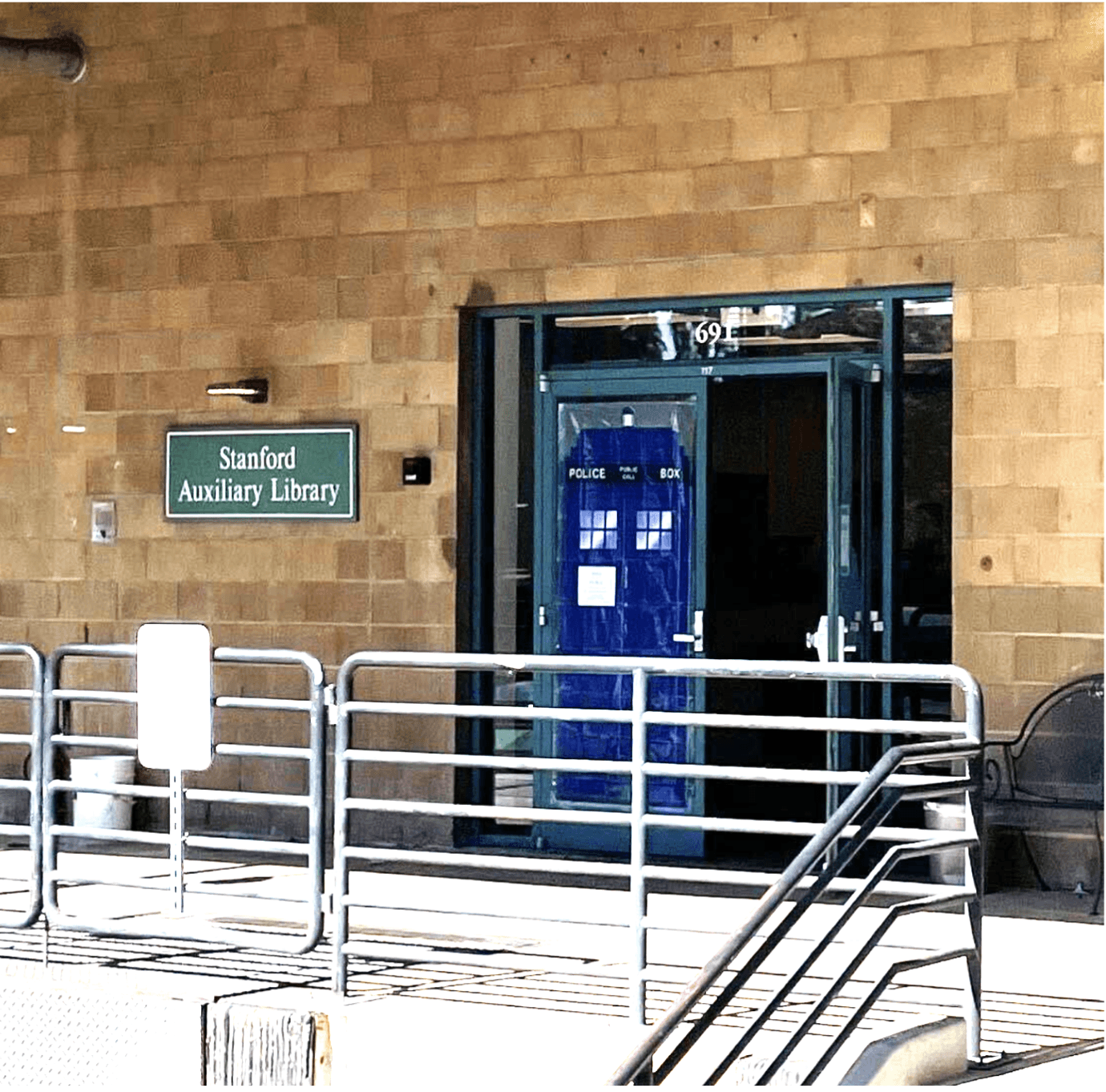
This is the first of a multi-part series describing the work of the Department of Special Collections & University Archives to organize and provide intellectual access to the archival collections and rare books previously shelved at the Stanford Auxiliary Library 2.
Over the past four years, a Stanford University Archives project team has surveyed, assessed, reboxed, described, and worked in collaboration with other Stanford University Libraries (SUL) units to make available for teaching and research over 12,000 boxes (more than 10,000 linear feet) of archival collection materials relating to Stanford history.
The materials had previously been stored at the Stanford Auxiliary Library 2 (SAL2), located at 691 Pampas Lane on the Stanford campus. Opened in 1993 to shelve over 750,000 books from Green Library during the repairs to the West Wing (later known as the Bing Wing) following the 1989 Loma Prieta Earthquake, the second auxiliary library became an important storage area for many of the archival collections and rare books comprising the Stanford University Libraries’ Department of Special Collections and University Archives.

For over 30 years, SAL2, built adjacent to the first Stanford Auxiliary Library (SAL1), served as the home to nearly 200,000 rare book volumes, 1,300 distinct archival and manuscript collections, and hundreds of thousands of other books and serials, many of which were poorly cataloged or under-described, limiting their discovery and use by faculty, students, and other researchers.
In Spring 2022, the University presented a proposal to decommission the buildings at 691 Pampas Lane under the terms of the General Use Permit with Santa Clara County. As part of the planning, the University offered the Libraries one-time funding and temporary space to process the materials housed at SAL1&2 and rehouse them elsewhere, including at the University’s high-density storage facility, Stanford Auxiliary Library 3 (SAL3).
Concurrent with planning for the closure of SAL1&2 and processing of the collections stored there, Stanford University Libraries (SUL) also began the transition to an open source integrated library system, FOLIO, and a new archival discovery platform, ArcLight. The availability of the collections previously housed at SAL2, along with these now-completed software implementations, enable a new era of exploration for rare and unique materials available through the Libraries.
Since 2022, as part of a larger effort across the Department of Special Collections & University Archives and the broader Stanford University Libraries, the University Archives team and its project staff have made available for research hundreds of archival collections relating to the history of Stanford University.

University Archives on the move
The Stanford University Archives is the official repository of records of Stanford University, and serves as its institutional memory. With holdings encompassing Stanford administration and governance, faculty research and teaching, students and alumni, campus activities and events, and Stanford’s relationships with Santa Clara County, the State of California, the region, and the world, the current extent surpasses six miles of archival records, manuscripts, photographs, maps and architectural drawings, posters, books, serials, and audiovisual materials, and over 60 terabytes of electronic records, within thousands of collections.
As the SAL2 project was rolled out across the Libraries, the University Archives was provided with an opportunity to remediate and consolidate approximately 10,000 linear feet of material stored at SAL2 in various stages of accessioning and processing. Beginning in Fall 2022, University Archives staff, including Hanna Ahn and Claudia Willett, worked to develop an understanding of the various components of the project, amended internal and library-wide workflows, and established a functional workspace at SAL2.

In Summer 2023, the University Archives was a fortunate beneficiary of funding to support the temporary hire of four professional librarians and three support staff. Project staff included Ruth Laraway, Eilene Lueck, Enid Ocegueda, Katherine Ramirez, Alyssa Brown, Lauren Caspersen, Paige Wilcox, and Kevin McGrath.
The team worked out of the SAL2 warehouse from July 2023 through April 2025. That April, the team’s work transitioned to 585 Broadway on the Redwood City Campus (RWC), where they processed the remaining collections.

In addition to the workspace at SAL2, during the first year of the project, an additional workspace was established in the lower level of Lathrop Library. This on-campus processing space utilized the collaborative efforts of the Department of Special Collections & University Archives, SUL Bibliographers, the Reference and Outreach team, and the Acquisitions department, who volunteered their time and subject expertise to assist with rehousing materials and providing container listings, helping to organize over one-thousand linear feet of collection materials.
The hundreds of collections and collection additions made available by the project team and SUL volunteers during the past four years include the records of Stanford administrators like Fred Terman and Ray Bachetti, the papers of notable Stanford faculty such as Clelia Mosher, George Dantzig, Susan Groag Bell, and John I. Brauman, as well as maps and architectural drawings, student photographs, event recordings, and university publications. All of these materials are now pageable for teaching and research in the Special Collections & University Archives reading room and associated teaching classrooms in Green Library.
Working hard, heartily working

Under University Archives staff guidance, the project archivists and project librarian led major processing and remediation projects at SAL2, Lathrop Library, and 585 Broadway. Contract staff provided necessary onsite support to the team. Every member of the group made an essential contribution to the overall success of the project, and they each gained experience and perspective on collection management, archival processing, and Stanford history.

Project Archivist Kathy Ramirez undertook small and medium collection processing throughout the length of the project, and also processed oversize materials. “This role required me to take on a higher level of responsibility than I’d ever needed to before,” Kathy says. “I balanced extensive documentation, communication with several involved parties, and overseeing the preparation and pick up of University Archives materials. I kept the end user in mind while balancing the priorities needed to sort through the high volume of materials required of the SAL2 project. I am leaving this position with a much more holistic understanding of archives in general, and with the confidence that I can process any collection I encounter.”
Project Archivist Eilene Lueck focused primarily on processing larger-scale collections, typically collections that exceeded twenty containers or more, as well as oversized materials. She also supported remediation of archival finding aids to support the launch of ArcLight. “My work has hopefully made these collections more navigable to researchers using the various discovery platforms used by the university,” Eilene explains. Eilene was also a key contributor during the Lathrop Library collection processing era in 2023. “Working collaboratively with both bibliographers and archivists was such a unique experience and, in the end, an incredibly productive one as well. Through our combined efforts we described and published over a thousand linear feet of previously undiscoverable materials.”
Project Librarian Ruth Laraway processed the Stanford University Publications and Ephemera Collection, comprising over 1200 feet of materials. She also updated and created over 600 catalog records for serial publications. “I became familiar with how to create new records for title changes or publisher changes, how to create bound-with records, and how to quickly spot inconsistencies and mistakes in old records,” Ruth maintains. “In my next role, I feel confident that I can continue building upon these experiences.” Ruth also successfully supervised the movement of all related materials from SAL2 to 585 Broadway to SAL3, where it is now pageable and easily accessible by researchers.

Processing Assistant Lauren Caspersen, who joined the project team in 2023, was instrumental in helping to process medium and large-sized collections. One of Lauren’s earlier successes was managing and executing the inventory, rehousing, and movement of 15,000 nitrate and safety negatives to cold storage. “Being able to say that I have worked on over 100 different collections at Stanford University,” Lauren shares, “makes me feel confident that the next role that I accept will be one that also challenges and encourages me to learn new archival methods, and strive for a clear method of organization that prioritizes order and discovery.”
Processing Assistant Alyssa Brown, who joined the project team in 2025, helped to process small and medium-sized collections. She made significant contributions while having the shortest tenure. After working through the collection addenda of the late Stanford Department of History faculty member, Paul Seaver, Alyssa noted, “I felt more connected to the materials and the creator upon completion of processing.” Alyssa also supported University Archives workflows by maintaining up-to-date shelf reads, and organizing the transport of materials to Conservation. Like all team members, Alyssa conveyed gratitude to SUL collaborators. She shares, “It took a lot of time on Conservation’s part to walk through each box with us, and we now know which items need work and where they are located.”
Although some members departed the team before the completion of the project, a spirit of comradery permeated the collective approach. All members of the group maintain that although much of the work was addressed independently, the interactions with colleagues fostered a dynamic and collaborative environment. “This experience was new to all of us,” states Lauren, “and we were learning things as we went, but it makes me grateful to have been a part of a larger team.”
The friends we made along the way
As the multi-year project reaches its conclusion, we would like to thank all of the many people whose hard work and dedication enabled the project’s success. In addition to the core project team—Josh Schneider, Hanna Ahn, Claudia Willett, Kathy Ramirez, Ruth Laraway, Eilene Lueck, Enid Ocegueda, Lauren Caspersen, Alyssa Brown, and Paige Wilcox—we would like to thank and recognize Michael Keller, Philip Schreur, Roberto Trujillo, Julie Sweetkind-Singer, Alexis Manheim, Tom Cramer, Bernadette Liu, Catalina Rodriquez, Amelea Kim, Kim Kay, and Nancy Fuller; and our colleagues in the Department of Special Collections & University Archives: Ben Stone, Ben Albritton, Glynn Edwards, Tim Noakes, Leif Erickson, Kylee Diedrich, Erin Thajudeen, Everado Rodriguez, Annie Schweikert, Franz Kunst, and Gurudarshan Khalsa.
We also appreciate the support from colleagues in Preservation / Conservation, including Richenda Brim, Ryan Lieu, Kristen St. John, Hannah Mosher, Sarah Newton, Beth Ryan, Jill Sison, and Aisha Wahab; SAL2 staff, including Leili Yu and Rene Aguirre; SAL3 staff, including Lelton Gibson and Samantha Koutsoftas; Facilities staff, including Roger Travenia and Ranelle Sharma-Vargas; DLSS staff, with particular thanks for the day-to-day support of Geoff Willard, Michael Angeletti, Kabir Hermon, Dinah Handel, Chris Hacker, and Linda Lam; and our Lathrop Basement Bibliographers, Learning and Outreach team, and Acquisitions department, with particular thanks to Sarah Sussman, Alma Parada, Eitan Kensky, Regina Roberts, Sarah Forzetting, Bogdana Marchis, Pauline Lewis, Phyllis Kayten, Zhaohui Xue, Rebecca Wingfield, Alex Threlkeld, Kathleen Smith, Felicia Smith, Liisi Esse, James Jacobs, Katie Keller, Azure Stewart, Linneah Shieh, Stella Ota, Ron Nakao, Margarita Nafpaktitis, Adan Griego, Kioumars Ghereghlou, Christine Garcia, Joshua Capitanio, Tamar Barzel, Amanda Whitmire, Lindsay King, Zoe Dilles, Kathy Kerns, Henry Lowood, and Kristen Greenland.
Claudia Willett and Hanna Ahn also contributed to this article.