Stanford Auxiliary Library relocation—Manuscripts
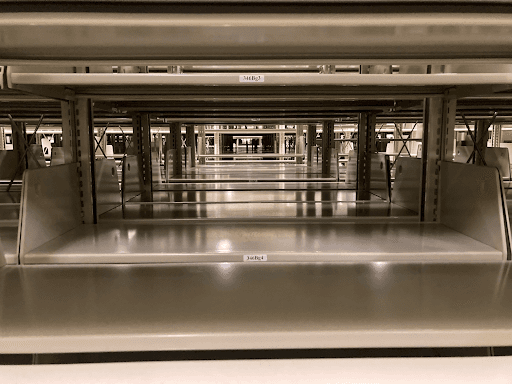
This is the second of a multi-part series describing the work of the Department of Special Collections & University Archives to organize and provide intellectual access to the archival collections and rare books previously shelved at the Stanford Auxiliary Library 2 (SAL2).
Outset—Manuscripts Division
The Division of Manuscripts contains items and collections acquired by many subject specialists across Stanford’s libraries. These rare and unique archival materials cover all eras and arrive in our department in both digital and physical formats. Physical components often include obsolete or modern audio, moving image, or computer media.
The Stanford Auxiliary Library (SAL2) storage facility on the main campus contained over 9,000 linear feet of manuscript holdings that we were charged with relocating to our permanent, climate-controlled storage facility (SAL3) in Livermore.
Unfortunately, relocating the collections was more complicated than just barcoding the boxes and sending them to permanent storage. The SAL2 storage facility was in use long before our permanent repository (SAL3) was built. It served as the primary location for incoming collections until they were processed and made available for research.
More than 830 collections were housed by the manuscripts division in SAL2, totaling about 10,000 containers of varying sizes. About 550 of these collections were categorized as “small,” which correlates to collections of 1 to 5 boxes.
Franz Kunst, our lead processing archivist, and I put together the initial plans to tackle this project back in the summer of 2021, when we first learned of the facility’s closure date. The project was broken up into different streams of work—different phases—depending on the size and complexity of the collections. Work was shared among various staff members, many of whom were term employees. The project’s actual start, with funding, was in February of 2022.
Manuscripts Division’s SAL2 team

To complete the project, we needed to extend three of our term-processing archivists. Once secured, our primary team then consisted of Franz Kunst, who would take on the overall day-to-day responsibility for the project, David Krah, Emma Frothingham, and Alyssa Tou. This is the team that was instrumental in working with our Facilities and SAL3 staff to create workflows for sending some material directly to permanent storage and then planning the massive relocation of almost 4,000 linear feet to the Redwood City processing space before the building was actually shut down.
Lathrop Library phase
One phase consisted of a planned side project to survey collections that were large, but fairly well-organized or included box listings from the donors. These were funneled through a separate workflow in another quickly renovated processing space on the main campus in the basement of Lathrop Library. This effort needed to be on the main campus to allow the Subject specialists, or Selectors, to survey this subset of large collections so we could send them to permanent storage with minimal box-level descriptions.
Archivist David Krah stepped in to manage the flow of collections into and out of the space as well as training and logistics for the work and publication of box listings. This project ended around nine months into the project.
Adjunct processing space on the Redwood City Campus
The rest of the collections were larger and needed more review than we could do on-site. These larger collections were relocated to a new processing space that was set up at the other end of the Stanford Redwood City campus from our main workspace. This vast, empty warehouse-like space would soon hold about twenty large processing tables, about 9,500 linear feet of shelving, and room for incoming and outgoing collections. By the fall of 2023, manuscripts had vacated SAL2 and shipped about 4,000 linear feet of collections to the Redwood City adjunct space.

Project staff
Franz Kunst, Project Manager
Franz was responsible for the day-to-day management of the project, both at SAL2 and in the adjunct space in Redwood City. He often took on the most disorganized and complex collections, but he also handled many of the smaller collections with very little description or little work done previously.
As challenging as this project has been, it has still been a chance to work on some very important and interesting collections. Here are a few examples:
Raúl Salinas (or raulrsalinas as he preferred) was a Chicano poet and political activist; the addenda to his collection were larger and probably richer than the materials we originally received. It was also classic archival synchronicity to work on his Free Leonard Peltier material just as Peltier was released from prison.
Leonard Koppett’s papers were the first and probably only sportswriter collection I’ll ever work on; it is also at least as much about journalism as about sports. After I wrangled the multiple duplicate photocopies of his nearly daily columns, it was actually a fun collection to work on.
Tapes and other recordings from venerable new-age radio program New Dimensions were finally organized and fully inventoried. This project involved publishing an alternative listing in spreadsheet form, and adding hyperlinks in the finding aid to programs that had already been digitized or were received in digital form.
In fact, there was quite a lot of media at SAL2, including film. At least two collections (the Herbert Matter papers and the Latin Tempo television programs from the National Council of La Raza records) are currently being digitized; stay tuned for some very exciting news on that front once the description is complete and they are published to our online discovery environment.
Doris Linder is not as well known but had an interesting career as a writer and historian focused on feminism, global reproductive rights, labor activism, and the Scandinavian diaspora. This was a completely unprocessed collection. Again, some subject areas not frequently encountered in our work.
One of the most unusual challenges encountered on-site at SAL was several large wooden cabinets full of glass lantern slides; these early 20th-century cabinets were specially designed for storage and access in libraries and schools. Although they are ingeniously constructed, safely removing the slides while keeping them in order was an involved process, and we can thank Winthrop contract staff member Kevin McGrath for keeping meticulous track while sleeving them in paper envelopes and placing them in boxes. The next step, as time and resources permit, is to review them and create a digital inventory. Many images appear to be mass-produced, but we would want to scan anything unique.

There were over 100 linear feet of addenda to the Allen Ginsberg papers; the processing of which is currently nearing the home stretch. This material covers the years from approximately 1994 to those following his death in 1997 and includes correspondence, unpublished writing, office files, and much, much more.
As we enter the final year in this massive project, several important collections are remaining to be processed, including the following:
- A large group of the William Saroyan papers has seen a first pass and awaits more detailed rehousing and organization. Additionally, while surveying them in Redwood City, we hosted a researcher interested in reviewing his unpublished work on behalf of the Saroyan estate.
- Perhaps most daunting are the multiple pallets and mapcase drawers of oversize and framed material, including 19th-century theater posters, San Francisco panoramic photographs, and a variety of lithographs and prints.
Although I do look forward to processing new collections again, there are further opportunities for backlog management based on all our experiences with TARDIS.
Emma Frothingham & Alyssa Tou
Onsite at SAL2, Emma and Alyssa took over the effort of checking all the small collections to verify that catalog records were complete, the boxes were in good condition, and then barcoded and sent the boxes to SAL3. They flagged small and medium collections that required additional work to go to Redwood City for further processing. Emma and Alyssa also worked together on oversize materials that were stored in the SAL2 oversize flat file cases. Once we set up our secondary workspace in Redwood City, the pair transitioned to working on larger collections from SAL2 that had not gone through the Lathrop processing space. Emma and Alyssa also worked collaboratively on materials from the extensive R. Buckminster Fuller papers (M1090) that had not been processed when the collection initially came to Stanford.
Queenie Don & Chinaenye Ibeanusi
We were also lucky enough to have some processing assistance from several contractors through the Winthrop Group, predominantly Chinaenye Ibeanusi and Queenie Don.

Staff assisting with project in addition to their regular focus
Gurudarshan Khalsa
Gurudarshan Khalsa, who had so ably dealt with large collections of ledgers from an earlier relocation project, jumped in to work on more ledgers from the Southern Pacific Railroad collection and others. Gurudarshan worked with Hanna Anh from University Archives and Jill Sison from the Conservation Department to assess whether any ledgers needed special housing or treatment before being prepared to be sent to SAL3. Some of the ledgers were in bad condition, were very heavy (over twenty pounds), or had fire damage before coming to Stanford. Gurudarshan checked to make sure the ledgers were included in the catalog records and then barcoded them and sent them off to SAL3.

Chris Doan & Chloe Pfendler
Our two Hohbach Archivists, Chris Doan and Chloe Pfendler, who focus on Silicon Valley, assisted by taking on the part-time processing of Silicon Valley Archives (SVA) collections from SAL2. Usually they are busy processing newly acquired collections taken from a priority list of researchers’ interest; but they dedicated one day/week over the course of this project.
Approximately 750 linear feet of SVA collection materials were removed from SAL2 and sent to Special Collections in Redwood City for processing, except the American Association for Artificial Intelligence records, which were first sent to Lathrop for a box survey prior to being shipped to Redwood City. The transferred SVA collections included personal papers; photographic materials; film, video, and audio recordings; computer media; and legacy computer hardware.
One of the collections processed from the SAL 2 project was the Communication Products Industry (CPI), Eimac media collection (M0917). The collection’s total extent of 70 linear feet consists mostly of photographic media, motion film, and sound recordings produced from the mid-1940s to late 1980s by Eitel-McCullough Incorporated (Eimac), an early innovator in the development and application of high-frequency radio vacuum tubes and radar technology founded in San Bruno, California in 1934. The company’s in-house produced media provides a comprehensive visual record of an early Silicon Valley technology company’s operations, research and development endeavors, and its labor force.
Another SVA SAL2 backlog collection brought over and processed at Redwood City was the Global Business Network records (M1958). Spanning about 30 linear feet, this collection documents the activities of a consulting and research organization called Global Business Network (GBN), which was founded in Berkeley in 1987 and later based in San Francisco. GBN used a method called “scenario planning” to strategically advise corporations, governments, and other entities. The records consist mainly of meeting reports and interviews, publications, public reports, white papers, training resources, reference materials, marketing materials, and business plans.
Also stored in SAL 2 were artifacts from the Apple Museum and legacy computer hardware, including a software manual from 1983 signed by Steve Jobs and Andrew Hertzfeld, and “The 10 Millionth Macintosh” manufactured in January 1993, among others. A portion of these unprocessed items have been rehoused and listed in the Apple Inc. records (M1007) finding aid’s Hardware and Artifacts series and are available to request for viewing.
Midpoint: Staff reduction
In the middle of the project, three archivists from the manuscripts core team accepted other term-funded positions in our department covering specific subject areas:
- Emma Frothingham was hired as our American History & Literature archivist
- Alyssa Tou, as our archivist for Art collections
- David Krah, as an archivist for the California Historical Society collections at Stanford University
This left one core archivist, Franz Kunst, working with our two Winthrop contractors: Chinaenye Ibeanusi and Queenie Don.
- Then a few months later, Queenie was hired as a processing archivist on the Dianne Feinstein project.
It was also at this time that I had to plan for the imminent arrival of over 7,000 linear feet of Senator Dianne Feinstein’s records. This effort began in the fall of 2023 and continued through the summer of 2024, when that team was all hired. And so, I leaned heavily on the expertise and dedication of our RWC staff—the primary SAL2 Team and others who jumped in to help with specific areas.
Wrap up—our final year of work
While the project is complete for the two divisions (University Archives & Rare Books) where staffing remained complete throughout, the Manuscripts Division was behind due to staffing shortages. Thankfully, on July 2, 2026, two of the archivists from the University Archives side of the project were extended to help complete the Manuscripts Division’s collections: Kathy Ramirez and Eilene Lueck. Stationed out at Stanford Redwood City’s adjunct space, they are addressing some of the larger backlogged collections from SAL2. These collections were identified as being the most “hands-on,” both in terms of physical requirements for housing and the complexity of processing needed to adequately describe the materials.

An early win for Kathy & Eliene was the processing of the Children’s Book Press records (M1863) addenda, a San Francisco non-profit organization that pioneered multicultural and bilingual children’s literature. Over 40 linear feet of this collection are now available upon request, including event photographs, posters, plates, proofs, and audiovisual media.
Work is ongoing for our newly constituted team, and wrap-up is expected by the end of August 2027.
The following staff contributed to this article: Franz Kunst, Emma Frothingham, Alyssa Tou, David Krah, Eilene Lueck, Kathy Ramirez, Queenie Don, Chinaenye Ibeanusi, Chris Doan, Chloe Pfendler, and Gurudarshan Khalsa.