The Stanford Commencement Archives
Two steadfast alumnae researchers uncover the legacy of women in the Physics Department.
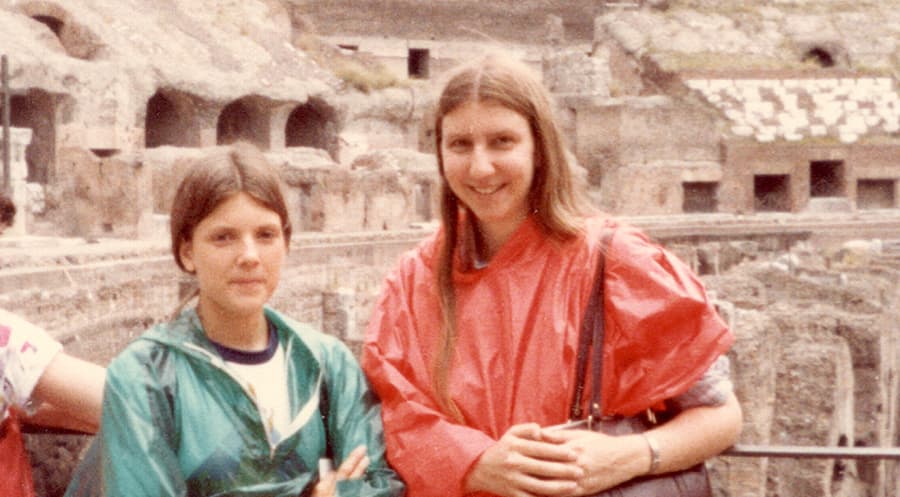
In an inspiring testament to the power of collaboration and archival research, Stanford alumnae Jill Marshall and Jane Alicia (Xan) Alexander have reignited a decades-old inquiry into the history of female graduates in the Physics Department. Their quest began in 1980, when the duo, both on the verge of graduating with B.S. degrees, stumbled upon a book labeled “Physics Grads.”
“I was shocked to find that there were women graduates recorded in the first year mentioned in the book, as I had thought we might actually be the first, and that there were years in the late 1940s when more women received B.S. degrees in Physics than in 1980,” Marshall recalled recently.
The memory holds even more poignancy as they discovered the book while waiting to meet with the department chair about the possibility of instituting course evaluations and his failure to inform them about a prestigious fellowship—the Grad Research Program for Women at Bell Labs—that Alexander learned about and successfully applied for at the last minute. Encouraged by their findings, Marshall created a graph depicting the number of women graduating per year over time, which she occasionally included in presentations about why women’s participation in Physics seemed to have peaked and fallen off, fluctuating near zero.

This narrative serves as a prelude to the present, where six scientists who studied at Stanford have published a tribute in Physics Today acknowledging the mentorship of the late experimentalist Stuart Freedman. They concluded that “his contributions to developing human capital in physics were as profound as his contributions in advancing its research agenda.” Alexander praised Freedman as “one of the few professors who didn’t care that I was female, only that I was a student to mentor and to respect as a junior colleague.” All six mentees completed PhDs in Physics – Alexander at the Massachusetts Institute of Technology and Marshall at the University of Texas, Austin.
To verify her original notes and identify the first year when women graduated, Marshall reached out to Stella Ota, the Physics Librarian and Head of the Li & Ma Science Library, requesting the “Physics Grads” book. Unfortunately, that copy, along with its compelling statistics highlighting the challenges of women’s representation, was never deposited in the Stanford University Libraries and remains unlocated. Ota, along with Corrie Potter, Associate Vice Provost and Director of Institutional Research & Decision Support, suggested that Marshall consult the commencement collections housed in the University Archives.
Following Marshall's inquiry, University Archivist Josh Schneider provided meticulously compiled data from the Stanford University Commencement Collection and suggested that she verify the majors in the digitized The Stanford Quad, which is available online from its first volume in 1894 to its 118th in 2014, when it was paused due to staffing shortages and subsequently revived by The Stanford Daily in 2017. Subsequent volumes are available in print in the Special Collections & University Archives reading room in Green Library. After reviewing the student-run yearbook, Marshall was able to arrive at a definitive, publishable statement: the Physics Department awarded more B.S. degrees to women in 1949 than it would in 1980.

“We so appreciate your assistance! It was several steps, but your recommendation got us there. I find I can always count on librarians to help” Marshall wrote to Ota. “These kind and encouraging words highlight the fundamental role of librarians to better enable researchers to navigate the landscape of information resources available to them, in this case, to connect the dots between discrete collections of archival materials and eventually to uncover the vital information needed,” Ota noted.
While researching, Marshall and Alexander discovered an archived project conducted at the Swain Chemistry & Chemical Engineering Library, which compiled a list of all faculty members and Chemistry graduates from 1891 to 1976. Inspired by this initiative, they plan to create a comprehensive list of Physics graduates through 1980 and submit it to Stanford for future reference. Their retrospective analysis aims not only to document the history of female participation in Physics but also to explore the careers and contributions of these graduates post-Stanford. Peter Michelson, Chair of the Physics Department, and An Nguyen, Assistant Director of Student and Academic Services, have generously agreed to help reconcile the recent findings from the archives with the departmental records.
In anticipation of Stanford Commencement Weekend 2026, when 13 women and 18 men are expected to graduate from the Physics program, the ongoing efforts of Jill Marshall and Xan Alexander serve as a reminder of the rich history preserved within the University Archives. “Stanford’s archival collections can provide unique and valuable insights that inspire new scholarship; Marshall and Alexander’s research shines a beacon on the overlooked participation and contributions of women in the sciences,” said Schneider. As inquiries and discoveries continue, this collaborative project paves the way for a more inclusive understanding of Stanford’s academic heritage.