A folder of possibilities
Stanford archivists rediscover a folder of 1940s proposals and correspondence around establishing an Institute of Public Affairs at Stanford.
During the survey stage of an ongoing University Archives administrative collections project, Archivist for Processing and Discovery Strategy Claudia Willett and Assistant University Archivist Hanna Ahn updated the description of a folder that uncovered a proposal by Stanford academics and administrators to establish an Institute of Public Affairs. Unlike the interdisciplinary Public Policy Program in the School of Humanities and Sciences that was founded in 1979, or the service-learning focused Haas Center for Public Service that was founded in 1985, the Institute of Public Affairs was conceptualized by Stanford faculty in the late 1930s into the mid-1940s to be a distinct academic unit within the School of Humanities and Sciences whose specialized coursework and scholarship would relate directly to the complex realities of public administration of the time.
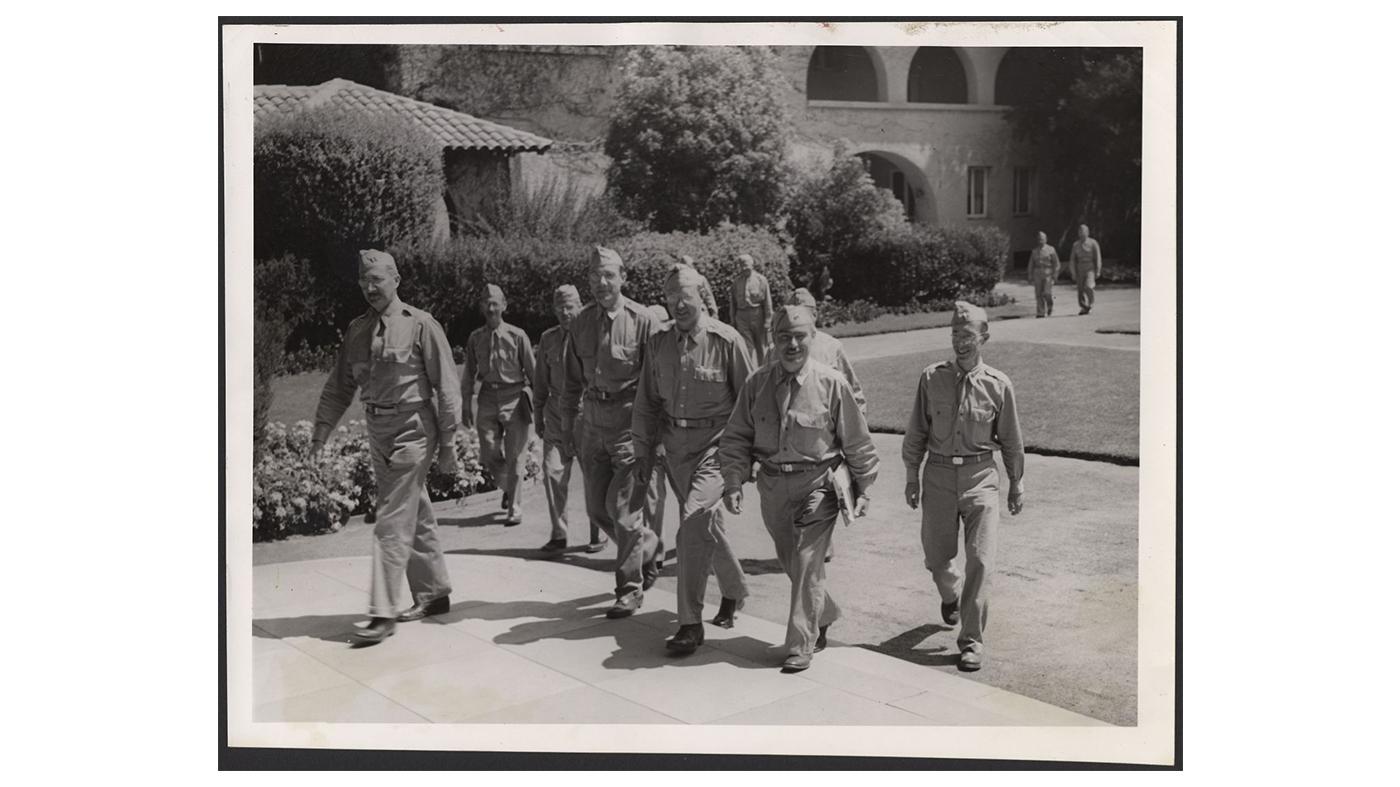
The files showcase practical and semantic discussions among faculty chairs regarding the proposed Institute from August 1937 until May 1944. The last documents of the proposal overlap with the implementation of the Civil Affairs Training Program (CATP) on campus, which provided an educational curriculum in defense-related fields and public affairs relevant to the impacts of World War II.
The wartime emergency programming of the CATP demonstrated the success of the university’s planning and coordinating functions, having educated and trained nearly 12,000 officers and service personnel, providing evidence to the discussions for a standalone Institute to develop and expand “the energies of the university” to “meet the current demand for adequately trained civil servants.”
In a 1937 memorandum, Edwin A. Cottrell, Professor of Political Science and Government, and Dean of the School of Social Sciences, noted:
Stanford University has an exceptional heritage for the establishment of a School of Government or Institute of Public Affairs. Mr. Stanford served as governor of the state and United States senator and in many of his letters and in the founding grant of the institution was particularly enthusiastic for training in the field of citizenship and public affairs. This institution has always been free from political pressure and has allowed its instructing staff to exercise their freedom of citizenship without restraint. Stanford graduates and faculty members have held many public offices with credit to themselves and the institution. The university has given them much freedom of expression on political and economic matters which is the essential purpose of democratic opportunities. A private university, free from political control, can be a great power house of civic energy.”
Dean Cottrell was already familiar with Stanford University’s fitness regarding the formation of such an institute. Hired in 1919 by the Department of Political Science to teach public administration courses, Cottrell had also been tasked with creating a plan for an institute of government to be operated by the department. Nothing came of the plan to implement an institute of government due to lack of funds and faculty research time for that initiative, but eighteen years later, the discussion and possibilities for funding resurfaced.

The June 1943 proposals centered on the creation of a Graduate School for Public Service that would focus primarily on curricula to provide new approaches to preparing personnel for administration, raise the standards of public service, and research problems related to the “functional operation and effect upon the general public.” Stanford alumnus and inaugural professor of Public Relations, Rex Harlow, remarked in one proposal on the current events of the war providing an opportunity to highlight “the critical needs involving personal safety and the perpetuity of free institutions, and challenge the greatest and most creative minds of their generation to take hold of the malleable forces at hand and shape them into a new and more productive way of living,” questioning the reader to think “what it would mean to have these forces consolidated behind the plan of training leaders who could understand the problems and needs of all, who could work for the interests of all.”
These proposals discussed the ideas and future flexible curricula of this new school theoretically, generating a wave of commentary from the promotion committee charged with developing ideas to create an institution which would prepare personnel for administration and raise the standards of public service. But it wasn’t until December 1943 that the proposal included a more robust summary of the problems involved in the creation of the institute and the financing it would require. Further discussed were issues related to the placement of the institution and potential friction and funding competition with existing schools and departments. From the packet of resurfaced materials, conversations regarding the proposed Institute of Public Affairs effectively ended in May 1944.
The history of a folder
Originally transferred to Stanford University Libraries by the Graduate Research Center of the Southwest at the University of Texas at Dallas in 1989, the folder (titled “Institute on Public Affairs - suggestions”) presented a challenge to Stanford’s archivists. While discussions of proposed academic institutes might be discussed in a variety of established contexts at the university, this particular conversation did not seem to rise to the level of garnering involvement from administrators of the time-period (including President Ray Lyman Wilbur, or his successor Donald Tresidder); likewise, related discussion could not be located in the Faculty Senate records or Board of Trustees meeting minutes. Without a clear context in which to place the folder, it persisted as a standalone small accession. The materials remained siloed for 36 years, until in 2025 a University Archives project team surfaced them again when revisiting a backlog of under-described small accessions.
Following the conclusion of the backlog project in 2026, Archivist for Processing and Discovery Strategy Claudia Willett began an administrative collections assessment project for University Archives; the mysterious folder once again rose to the forefront. This reintroduced the question once again: “where does this folder belong?” Willett teamed up with Assistant University Archivist Hanna Ahn to attempt to resolve this question once and for all.
Willett and Ahn collaborated to better understand the provenance, meaning, and impact of the Institute of Public Affairs proposals and correspondence. Based on her work with other materials from the Office of Development, Ahn identified evidence that the conversation took place in a broader context of potential fundraising for the civics-minded school through the General Secretary’s Office, the precursor to the contemporary Office of Development that was responsible for soliciting gift funds and bequests for Stanford. Finally, the folder had found an appropriate administrative home to better support future discovery.
Conclusion
The journey of these documents brings to mind the phrase Pro captu lectoris habent sua fata libelli, that books have destinies of their own. It is interesting that this collection of memoranda, meeting materials, comments, and questions surrounding a proposal that did not materialize in its own time has resurfaced as questions again arise around trust in government and public institutions, including higher education.
As Harlow noted in the June 1943 proposal, “Ideas move the world. And so what we need today is an idea, a plan, so compelling in conception and scope, so forthright and appealing that it will capture the imagination of people throughout the nation. It will have to be an idea based on truth. It will need to be addressed definitely and clearly to the needs of the times so that everybody who comes in contact with it will recognize this fact. It will have to sparkle with life and vitality in order to arouse enthusiasm. It must appeal to both the classes and the masses.”

In reflecting on both the intellectual and physical history of these files, at an institution situated in the heart of Silicon Valley, whose technological innovations in recent decades have created an entirely new world from the one in which these proposals were created, ideas have moved the world—they have been enacted into forces of creation, into new ways of understanding and moving and sharing.
Yet, the tension between the stated values and goals of an organization and how effectively they meet those standards is directly reflected in the challenges facing higher education now. The Stanford Civics Initiative represents one of the most recent visible commitments and interpretations of the University’s public service mission, and campus perceptions of its methods and successes vary. The historical optimism of war-weary faculty and staff is a reminder that a part of the social contract between the public and universities is to wonder aloud what more can be done.